How Do You Spot Bald Eagles in Alaska?
Travel Tuesday: We’re returning to Alaska today with our eyes on the treetops and one surprisingly useful piece of eagle-spotting advice.
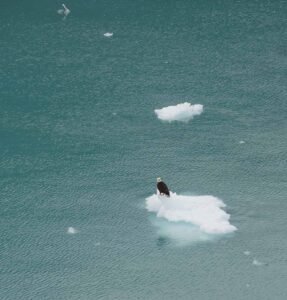
Of all the places I expected to see a bald eagle in Alaska, standing on a chunk of floating ice was not one of them.
But there she was, just off our balcony aboard the Queen Elizabeth, riding along on the turquoise water as if floating past a cruise ship were a perfectly ordinary part of her day. For her, perhaps it was.
Whenever we travel, I’m hoping for an animal encounter. Elk near Cherokee, North Carolina. Lemurs in Prague. Whales rising from the water in Alaska.
There’s something about seeing wildlife in its own habitat that makes you feel more connected to the place.
Wildlife was one of the reasons we chose Alaska, and Alaska delivered: orcas, humpback whales, harbor seals, ravens and bald eagles.
Lots of bald eagles. Today, let’s look up and focus on them.
How Do You Spot Bald Eagles in Alaska?
Our naturalist guide gave us one wonderfully simple tip:
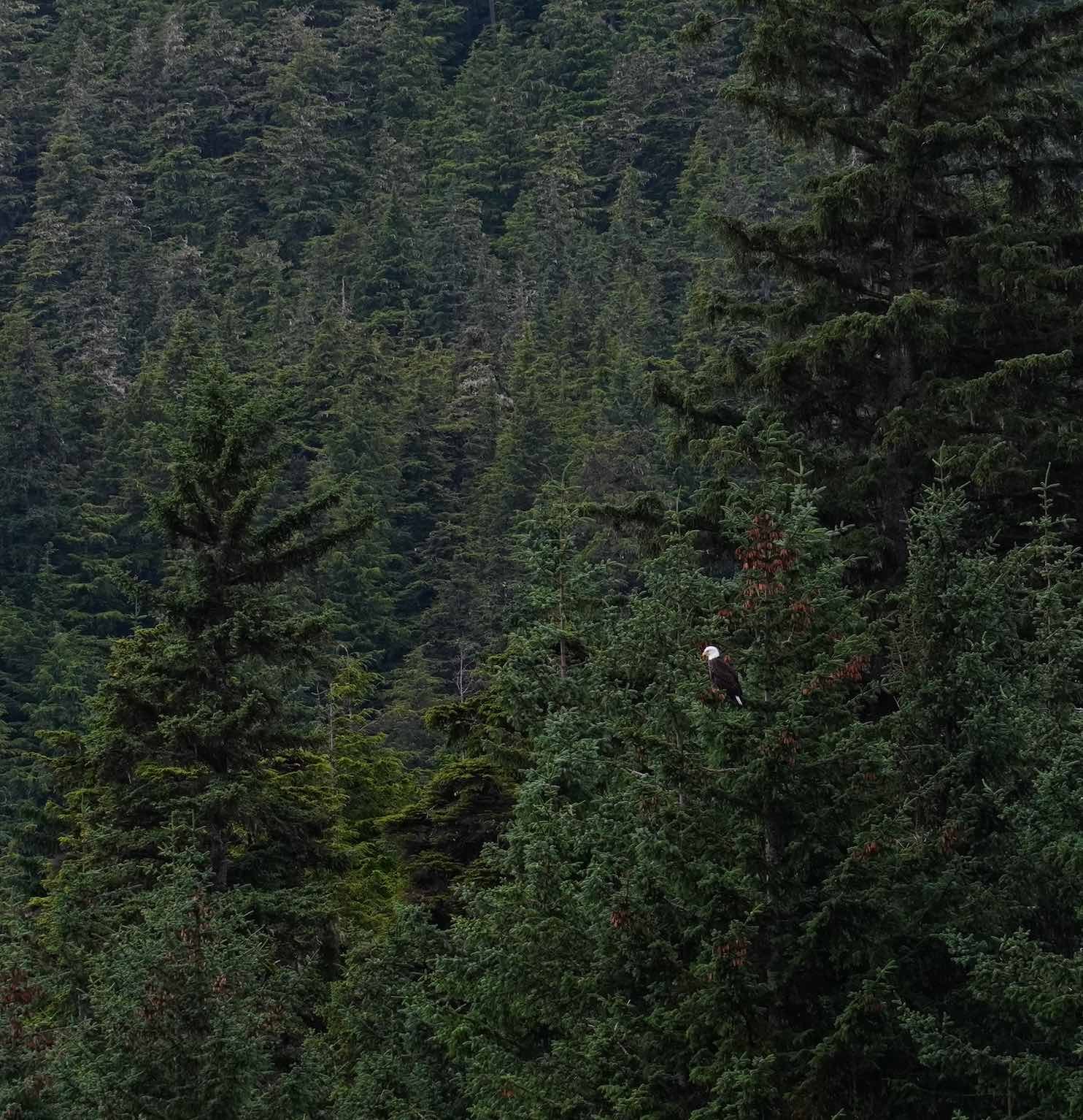
Scan the treetops for what looks like a little white golf ball.
That small white spot against the dark green trees is often a mature bald eagle’s head.
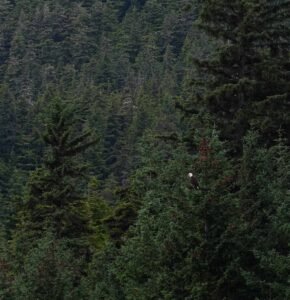
Once she told me what to look for, I began seeing eagles everywhere.
One flew right past us in downtown Haines. A juvenile watched from the trees near Creek Street in Ketchikan. Another stood fishing in a stream. We saw eagles during walks, wildlife tours and quiet moments from the ship.
Every sighting felt like a small win.
It also reminded me of something I know as a photographer but sometimes forget as a traveler: the more carefully you look, the more the world reveals.
Why Don’t Juvenile Bald Eagles Have White Heads?
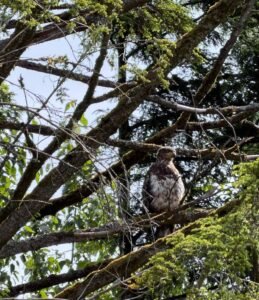
The young eagle I spotted near Creek Street didn’t look like the familiar American symbol.
Juvenile bald eagles have mottled brown and white feathers. They gradually develop their distinctive white heads and tails, yellow bills and lighter eyes as they mature, generally reaching their adult coloring around age five.
Despite their name, bald eagles are not bald. The word comes from “piebald,” referring to their contrasting dark and white coloring. Their scientific name, Haliaeetus leucocephalus, means “white-headed sea eagle.” The National Park Service explains more about the bald eagle’s name and appearance.
Meeting Bella in Haines
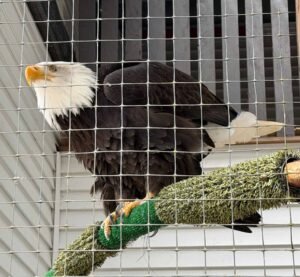
At the American Bald Eagle Foundation in Haines, I met Bella, a female bald eagle who hatched in 2010.
Bella was injured after flying into power lines as a juvenile. Because she could not safely return to the wild, she became an avian ambassador.
Getting close enough to study her eyes, feathers, and formidable talons was completely different from spotting an eagle overhead.
The American Bald Eagle Foundation is dedicated to preserving bald eagles and their habitat through education and stewardship. It is especially at home in Haines, near the Alaska Chilkat Bald Eagle Preserve.
The 48,000-acre preserve protects critical habitat along the Chilkat River. It contains more than 80 bald eagle nests and a year-round population in the low hundreds. During the late salmon run, more than 3,000 eagles may gather there between October and January, according to the Alaska Department of Fish and Game.
Eagle Drama at the Alaska Raptor Center
At the Alaska Raptor Center in Sitka, I watched two longtime resident bald eagles walking around the habitat below us.
These rehabilitated birds could not be released into the wild, but they were lively, alert, and unmistakably eagle-like.
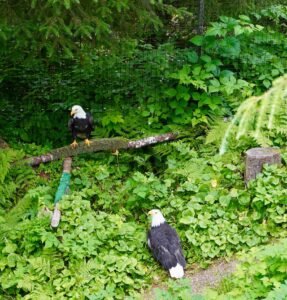
Then a wild mother eagle appeared overhead, flying back and forth to her nearby nest.
The two resident eagles noticed her immediately. They watched every move she made with intense interest.
I asked our guide what was happening.
“These are not nice birds,” he said plainly.
Bald eagles can be extremely territorial, particularly when protecting nests, mates and food. Majestic? Absolutely. Likely to welcome a new neighbor with a shared meal? Apparently not.
I asked him if Harris’s hawks were unusual among raptors because of their social behavior. He confirmed that they were. Harris’s hawks are known for living and hunting cooperatively, unlike most other raptors.
I’ve seen a Harris’s hawk before at the Carolina Raptor Center back home, so our Alaska encounter unexpectedly connected with one in North Carolina.
The Alaska Raptor Center rescues and rehabilitates injured bald eagles and other birds. Its goal is to return birds to the wild whenever possible. Birds that cannot be released may become educational ambassadors, giving visitors a closer and more honest understanding of how raptors live.
How Large Is a Bald Eagle’s Nest?
While visiting the Alaska Raptor Center, I stepped inside a life-size replica of a bald eagle’s nest and asked our guide Sarah to take my picture. Thank you, Sarah!

You do not fully appreciate how enormous these nests are until you are standing inside one.
A typical bald eagle nest measures approximately four to six feet across and three feet deep. Eagles frequently return to the same nesting territory and add more material each year. Over time, a nest can grow much larger and weigh more than 1,000 pounds.
Less bird’s nest, more treetop condominium.
Eagles generally build near coastlines, rivers and large lakes where food is readily available. They often select tall, sturdy trees that provide a clear view of the water and branches strong enough to support the nest.

During Alaska’s breeding season, bald eagles actively defend the territory surrounding their nests. The U.S. Fish and Wildlife Service recommends observing nesting eagles from a respectful distance to avoid disturbing them.
The Eagle’s Place in Tlingit Culture
It would be misleading to assign the eagle one universal “Native American meaning.” Indigenous nations have distinct cultures, histories and relationships with eagles.
In Southeast Alaska, where many of my sightings took place, the eagle has a specific and living place within Tlingit culture.
Tlingit society is traditionally organized into two complementary groups, or moieties: Raven and Eagle, known as Yéil and Ch’áak’. More than simply decorative animal symbols, the moieties are part of a matrilineal social structure connecting identity, clans, relationships, responsibilities and reciprocity.
According to the Sealaska Heritage Institute, the two moieties help create cultural balance.
That gave my eagle encounters another dimension. The eagle can represent more than individual power. Within this specific cultural tradition, it is also connected to identity, relationship and one’s place in a larger community.
A Fitting Sight in America’s 250th Year
The bald eagle became part of the Great Seal of the United States in 1782.
Seeing bald eagles throughout Alaska felt especially meaningful during America’s 250th anniversary year. Yet the eagle’s story is about more than symbolism. It is also one of resilience and recovery.
Habitat destruction, illegal shooting, poisoning and the pesticide DDT once drove bald eagle populations dangerously low in the Lower 48. Legal protections, cleaner waterways and decades of conservation work helped the species recover enough to be removed from the federal endangered species list in 2007.
Today, bald eagles are more abundant in Alaska than anywhere else in the United States. The Alaska Department of Fish and Game estimates that approximately 70,000 bald eagles live in the state, with some of the highest nesting densities in Southeast Alaska.
The Travel Lesson: Look More Closely
A juvenile half-hidden in a Ketchikan tree would have been easy to miss.
An eagle fishing in a stream could have blended into the shadows.
The eagle standing on floating ice might have been nothing more than a distant speck if I hadn’t stepped onto the balcony and looked.

Perhaps that’s what these encounters taught me about connecting with wildlife.
On your next trip, slow down. Look toward the water. Scan the tallest trees.
That little white golf ball might turn out to have wings.
Where Can You See Bald Eagles?
If you are traveling in Southeast Alaska:
- Visit the American Bald Eagle Foundation in Haines.
- Visit the Alaska Raptor Center in Sitka.
- Scan tall trees near coastlines, rivers and salmon streams.
- Watch for a white “golf ball” among the evergreens.
- Remember that juvenile bald eagles will not have completely white heads.
- Observe wild eagles and their nests from a respectful distance.
If you are in North Carolina, visit the Carolina Raptor Center in Huntersville. Its Raptor Trail is home to more than 30 avian ambassadors, including bald eagles and other fascinating birds of prey.
All wildlife photographs © 2026 Barbara Rozgonyi.
What is the most memorable wildlife encounter you’ve had while traveling?