AI Collaboration: The Third Person in the Room
What Happens When AI Becomes the Third Person in the Room?
How can AI collaboration add creativity, judgment, and real intelligence? Recap from the September 18, 2026 Charlotte Marketing AI Exchange event by Barbara Rozgonyi.
What changes when you stop treating AI like a vending machine and start treating it like a collaborator?
That question stuck with me after attending “Claude Workshop: The Left Brain + Right Brain Approach to AI,” presented by the Charlotte Marketing AI Exchange at Wray Ward in Charlotte. The session gave me one of the clearest examples of real AI collaboration I’ve seen in a live setting.
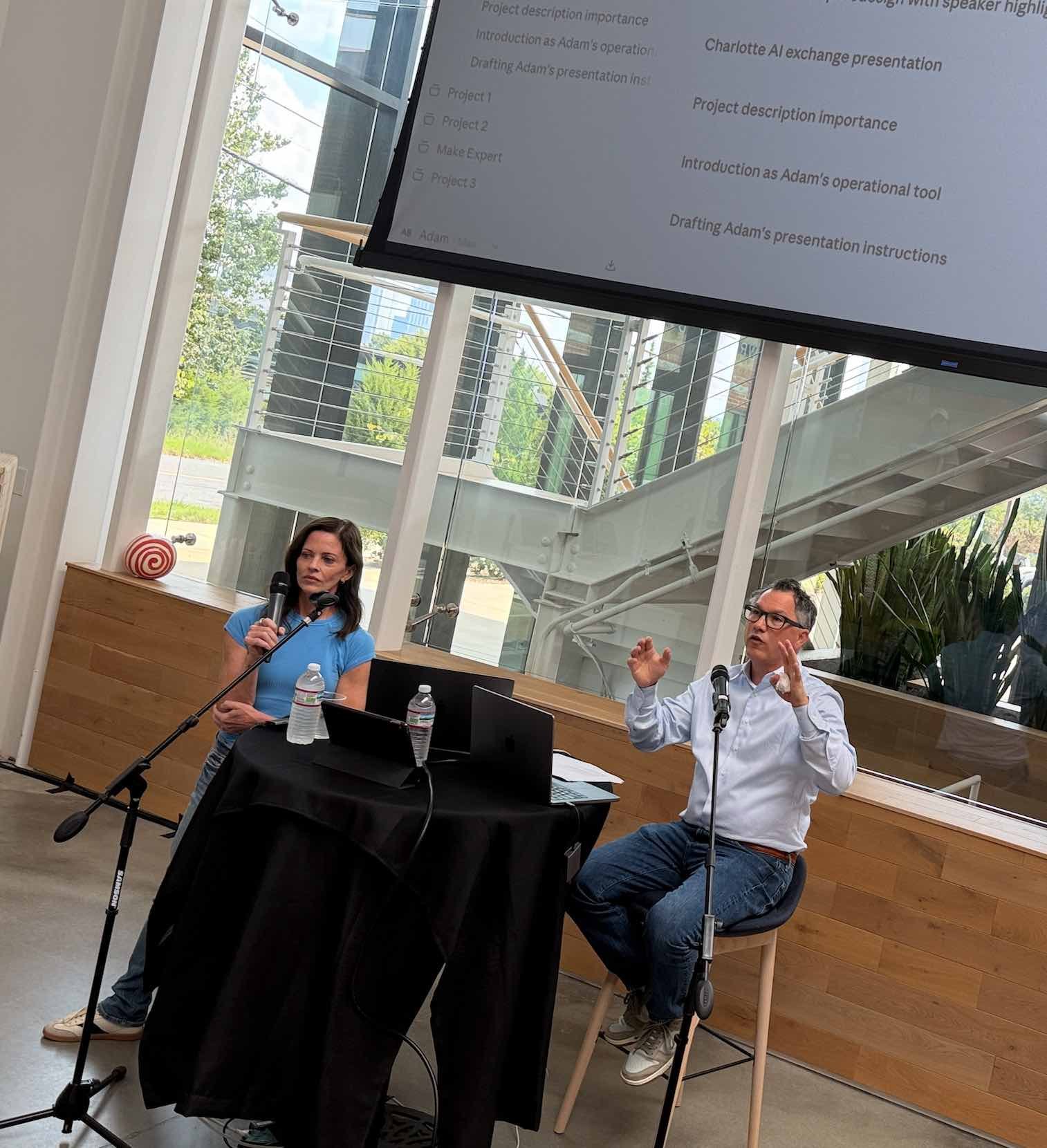
The workshop was led by Adam Bartimmo, Technology Senior Director, and Buffy Kelly, Senior Director, Insights and Brand Strategy, at Wray Ward. Adam brought the operational, linear-thinking perspective. Buffy brought the creative, lateral-thinking perspective.

The most interesting moment came when Claude became the third presenter in the room.
Claude didn’t just generate a few slides or polish the speakers’ notes. Adam and Buffy invited it into the process. They gave it a role, a voice, and a point of view. First, they showed us the generic presentation it produced from a basic request. Then they took us behind the scenes to see how context, instructions, source material, and continued conversation made the work more thoughtful, distinctive, and human.
It wasn’t a flawless technology demonstration, either. One presenter’s computer stopped cooperating right at the start. Perfect. The glitch drove home the whole lesson: AI may be in the room, but people still have to read the room.
AI Plus RI: Real Intelligence
Adam drew an important distinction between using AI for efficiency and using it for effectiveness.
Efficiency helps you finish something faster.
Effectiveness helps you produce something better, explore possibilities you might not have reached alone, and free up more room for the work only you can do.
He described humans as the RI: real intelligence. We decide what “done” means. We set the boundaries. We recognize when an answer is technically acceptable but strategically wrong. We decide what matters.
The workshop itself proved his point. When the technology faltered, Adam and Buffy adapted, talked with the audience, and kept the experience moving. You can’t automate the chemistry between an operational thinker and a creative thinker. AI didn’t replace either brain. It expanded what the two brains could do together.
The First Answer Is Usually the Floor, Not the Finish
Most people still use generative AI this way:
- Type a request
- Get an answer
- Decide the answer is bland
- Rewrite it themselves
That’s not collaboration. It’s a one-transaction relationship with a very fast intern.
Buffy showed a different approach. She works with AI organically, sometimes messily, and keeps refining the relationship. She tells it what she likes, what she doesn’t, what she considers merely good, and what “great” looks like to her. She shares turns of phrase and examples and asks it to remember them.
Her point wasn’t to pretend a machine is human. It was to show that better inputs aren’t limited to better prompts. They can include stories, reactions, fears, standards, preferences, and judgment.
Left on its own, Claude can give you a plausible, familiar answer. Your taste and experience help the work rise above average. The technology is the floor. You’re the ceiling.
Give AI the Right Lens, Not Everything You Have
One of the most useful practical lessons was how to work inside a project instead of starting with a disconnected chat every time.
A project isn’t just a folder for conversations and files. It gives AI a lens for understanding what you’re creating. Its description can be short and useful to you and your team. Its instructions hold the goals, voice, boundaries, and working relationship you want AI to remember.
Those instructions don’t have to be perfect before you begin. They can evolve as the work evolves. Buffy said she’ll often change them several times during a project as she discovers what the work needs and what kind of collaborator she needs Claude to become.
Source material is where the work becomes more human. Feed the project the information that’ll help it understand the assignment:
- Your frameworks and points of view
- Transcripts of successful presentations
- Examples that demonstrate your voice and taste
- Audience profiles and what those people have already seen
- Stories, research, and facts the work must reflect
But don’t feed it everything just because you can. More context isn’t automatically better context. A smart human still has to decide what belongs, what doesn’t, and which information should guide the work. The more unrelated material you add, the more chances AI has to wander off course.
Give It Boundaries and Permission to Challenge You
Adam recommended including at least three “nevers” in your project instructions. For example:
- Never invent facts, quotations, or sources
- Never make the message sound like generic corporate AI copy
- Never make the final strategic decision for me
Explaining what great looks like matters. Explaining what failure looks like can matter just as much.
AI doesn’t always have to agree with you, either. Depending on the assignment, ask it to work as a collaborator, peer, skeptical reviewer, or adversary. Invite it to challenge your reasoning, find what’s missing, and flag where an audience might lose interest or trust.
Before you ask for the finished product, try saying:
Don’t produce anything yet. Tell me what you see, what may be missing, and what questions you need me to answer.
That one instruction turns AI from an eager content generator into a more thoughtful collaborator. It also gives you a chance to correct its assumptions before they turn into a 25-slide presentation.
What This Means for Thought Leaders, Marketers, and PR Professionals
AI can produce more content than most organizations could ever publish. Volume isn’t the scarce resource anymore. Judgment is.
Marketing and PR leaders shouldn’t ask only, “How can we create this faster?” Better questions include:
- What can our people see that the system can’t?
- What does our audience need to feel, understand, or do?
- Which stories, proof points, and lived experiences make this ours?
- Where could a polished AI answer damage trust?
- What would make this communication meaningful rather than just competent?
AI can help organize research, compare options, challenge assumptions, and explore creative territory. Human leaders still have to protect accuracy, reputation, relationships, and intent.
That’s not a small role. It’s the role.
What This Means for Meeting Planners and Association Leaders
For meeting professionals, the workshop also modeled a more useful kind of AI program.
Instead of another parade of predictions, it let attendees watch people work with AI in real time. We saw different thinking styles, an imperfect first result, a technical failure, adaptation, and improvement. The audience didn’t just hear that humans should stay in the loop. We watched it happen.
When you’re planning AI education for members or leadership teams, consider designing an experience that:
- Pairs speakers with contrasting strengths
- Uses a real organizational challenge rather than a canned demonstration
- Shows the weak first draft and the path to a stronger result
- Gives participants time to work with their own material
- Addresses governance and approved tools without letting policy swallow the program
- Ends with a small practice participants can use right away
People don’t need another speaker to tell them AI is changing everything. They need help figuring out what to do differently on Monday.
Put Your AI Collaboration in the Right FRAME
The session also got me thinking about my Brighter Presence FRAMEwork™. Whether a message is created by one person, a team, or a team working with AI, it should help expertise become:
- Findable: Can the right people and AI systems discover it?
- Recognizable: Does it sound and look distinctly like you or your organization?
- Authoritative: Is it accurate, credible, and backed by real expertise?
- Meaningful: Does it connect with what people care about?
- Easy to Choose: Does it make the next decision or action clear?
AI can help with every part of that FRAME. It can also weaken every part if speed outruns judgment.
A generic answer might be findable without being recognizable. A confident answer might sound authoritative without being accurate. A beautifully written answer can still be meaningless to the person who needs it. More content doesn’t automatically create a Brighter Presence™.
The goal isn’t manufactured visibility. It’s accurate visibility: helping the right people find you, understand you, trust what they see, and recognize the value that’s already there.
A Simple AI Collaboration Exercise for Your Next Project
Before asking AI to draft your next campaign, presentation, or proposal, give it three things:
- The outcome. What should change because this work exists, and who needs it?
- The evidence. Share the facts, stories, and examples that make the work yours.
- The boundaries. Explain what a good result looks like and what AI must never invent or assume.
Then ask what’s missing before it starts writing. React to the first draft, let it try again, and make the final judgment yourself.
That may take longer than accepting the first answer. It’s more likely to produce something worth using.
Frequently Asked Questions About AI Collaboration
Should you give your a AI assistant a personality?
Giving it a role, voice, boundaries, and working style can make its responses more consistent. That doesn’t make AI human. It just gives the collaboration clearer direction.
Why use an AI project instead of a single chat?
A project can hold ongoing instructions, selected source material, and multiple related conversations. That creates continuity and gives AI a consistent lens for understanding the work. The instructions can evolve as the project develops. Features and terminology vary by platform and plan, so follow your organization’s approved tools and policies.
How do you make AI-generated content sound less generic?
Supply original source material, define the audience as a real person, share examples of what “great” means, say what you never want, and respond with specific reactions over several rounds. Then add human experience, verification, and judgment.
Can AI replace creative or strategic professionals?
AI can speed up research, synthesis, exploration, and production. It can’t take responsibility for an organization’s reputation, understand every human consequence, or make accountable strategic decisions. The more consequential the communication, the more important real intelligence becomes.
The best question I brought home wasn’t, “What else can AI do?”
It was: What could we do together that neither AI nor I would’ve reached alone?
That’s where AI collaboration becomes more than a place to type notes or ask, “Can you make this better?” AI becomes a thinking partner. It’s not the decision-maker, the expert, or the human in the room. It’s the third collaborator.
Thank you to Charlotte Marketing AI Exchange founders Tammy Tufty and Jessica Hreha, presenters Adam Bartimmo and Buffy Kelly, and Wray Ward for an engaging look behind the curtain.
If your leaders have more expertise than people can see, I’d welcome the conversation about closing the Expert Gap™ and building a Brighter Presence™. Explore AI leadership visibility keynotes, workshops, and strategic consulting.