How to Find Better Speaking Opportunities and Win Bigger Gigs
By Barbara Rozgonyi | October 16, 2026
Before you spend another afternoon answering a call for proposals, ask yourself a simple question: Is this a room where your expertise can make a difference, reach the right people, and support the business you want to build?
Learning how to write a winning conference proposal starts with understanding the opportunity. Who attends? What do they need? What experience can you bring? And is the potential value worth the time you’ll invest?
How to Find Better Speaking Opportunities and Win Bigger Gigs
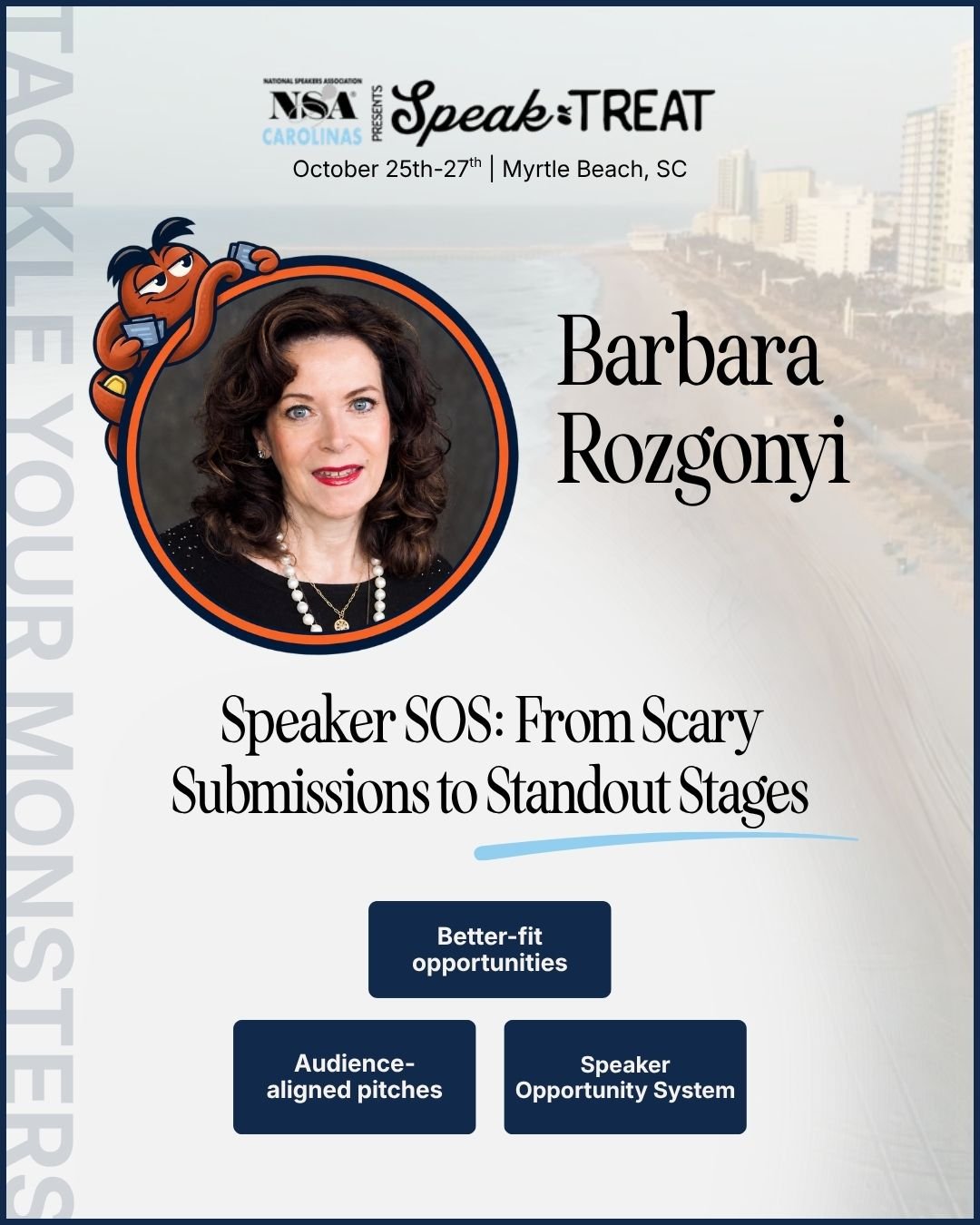
That’s what we’ll work through in Speaker SOS: From Scary Submissions to Standout Stages, my 90-minute working session at NSA Carolinas’ Speak or Treat retreat in Myrtle Beach, South Carolina. On Monday, October 26, we’ll use my FRAME Method to evaluate speaking opportunities, develop stronger proposal components, and choose a concrete next step.
The idea behind the session is simple: Better targets beat more submissions.
What You’ll Build in Speaker SOS
If you’re a speaker, consultant, trainer, or subject-matter expert who uses speaking to grow your business, this session gives you a process for deciding where to focus your effort.
Whether you’re preparing your first proposal or refining an established speaking business, you’ll work on opportunities you’re considering.
You’ll work toward:
- A ranked target list: Three to five speaking opportunities scored for audience fit, business value, and effort.
- A decision on your top opportunity: Pursue it, adapt your angle, ask a question first, or pass.
- An audience outcome statement: A clear explanation of what participants will be able to do and why it matters.
- Core proposal components: The audience need, your relevant experience, your session approach, and the expected outcome.
- A dated next step: A specific action supported by a reusable workbook, proposal template, and opportunity tracker.
You don’t need to finish an entire submission during the session. The goal is to leave with clearer decisions and work you can use.
What Is a Call for Proposals for Speakers?
A call for proposals, also called a call for presentations or CFP, invites potential speakers to submit session ideas for consideration. Organizers may request a title, description, learning outcomes, speaker bio, video, and other materials.
Each event sets its own deadlines, selection criteria, session formats, and speaker compensation policies.
An open submission form tells you the organizer is accepting ideas. Research helps you decide whether yours belongs there.
Before writing, read the event requirements, audience information, and speaker benefits. If an important detail is missing, identify the question you need answered.
How to Write a Conference Proposal Using FRAME
FRAME is my five-step process for choosing speaking opportunities and making a stronger case for selection:
Find → Research → Assess and Align → Make the Case → Engage
F: Find
Build and score a shortlist of potential events.
Consider:
- Are people who hire speakers or trainers likely to attend?
- Is compensation offered?
- Does the audience match the people you want to serve?
- Does your program address the event’s theme?
- Do you have relevant experience and evidence?
- Could the engagement lead to other worthwhile opportunities?
- How much time, preparation, and travel will it require?
A recognizable event name can be appealing. These questions help you decide whether it also fits your business.
R: Research
Learn who will be in the room, who selects speakers, and what the organizer wants participants to learn or do.
Start with the event website, CFP instructions, speaker benefits, and past programs. Separate what the organizer states from what you infer.
If compensation, travel support, recording rights, or another important condition is unclear, write down the question before you invest more time.
You might ask:
“What is the most important challenge you want this year’s sessions to help attendees address?”
That answer can help you assess fit and develop a more relevant proposal.
A: Assess and Align
Use the Trick or Treat Test to choose your route:
- Treat: The opportunity fits your audience, expertise, and business goals. Pursue it.
- Costume Change: The audience is a good match, but your program needs a different angle.
- Knock First: An important fact is missing. Ask before spending more time on the submission.
- Trick: The value doesn’t justify the effort. Pass and consider another target.
Unpaid opportunities deserve the same thoughtful assessment. Identify the specific value, costs, and realistic potential for follow-on work.
In my Speaker SOS scorecard, an unpaid opportunity needs the highest score of 2 in either Buyers in the Room or Downstream to merit consideration. Passing that test is a reason to investigate further, not an automatic yes.
M: Make the Case
Help the selection committee understand the audience’s problem, your relevant experience, and what participants will be able to do afterward.
Start with this outcome sentence:
After this session, [audience] will be able to [result] so that [benefit to their organization].
For example:
“After this session, new managers will be able to structure a feedback conversation so that they can address performance concerns earlier and set clearer expectations.”
Then build your proposal around that outcome:
- A title that communicates the session’s subject and value.
- A description that explains the audience need and your approach.
- Learning outcomes appropriate to the session’s length.
- An explanation of what participants will do in the room.
- Relevant experience or evidence supporting your ability to deliver.
- Every field, link, and permission the organizer requests.
Follow the CFP’s word limits and instructions. Make it easy for the committee to explain your session’s value to colleagues.
E: Engage
Give each opportunity a specific next step.
That might mean asking a question, submitting your proposal, recording the confirmation, or scheduling a follow-up that respects the organizer’s guidance.
Keep the event, contact, deadline, status, and next action in one place. A useful tracker helps you return to the relationship without having to reconstruct the conversation.
Where AI Can Help With Speaker Proposals
AI can help you review public CFP requirements and critique a draft you’ve written.
Ask it to identify:
- Missing submission requirements.
- Vague learning outcomes.
- Unsupported claims.
- A mismatch between your session and the stated audience.
- Questions you should resolve before submitting.
Check its feedback against the original source. Your examples, results, stories, and judgment provide the substance of the proposal.
AI shouldn’t invent client outcomes, credentials, or audience needs. In Speaker SOS, these exercises are optional aids to the work. Lynn Unsworth’s retreat session explores AI and authentic influence in more depth.
What Speaker Proposals Have to Do With Leadership Visibility
A conference proposal asks you to explain why your expertise matters to a particular audience. Leaders and consultants face that same challenge when introducing themselves, pitching an idea, or describing their services.
I call the distance between the expertise you’ve earned and what others recognize the Expert Gap™.
An audience outcome backed by relevant proof helps make your value visible. It gives an organizer something specific to evaluate and a reason to consider you.
For association leaders planning member education, that means proposals connected to member needs. For speakers, consultants, and business leaders, it means explaining what your expertise can help people accomplish.
Join Us at Speak or Treat in Myrtle Beach
NSA Carolinas, a National Speakers Association Elite Chapter, hosts Speak or Treat October 25–27, 2026, at Embassy Suites by Hilton Myrtle Beach Oceanfront Resort at Kingston Plantation in Myrtle Beach, South Carolina.
My Speaker SOS working session takes place Monday, October 26.
The retreat program also features:
- Jane Jenkins Herlong: Take Off the Mask: Your Greatest Speaking Asset Is You.
- Lynn Unsworth: Beyond the Prompt: From Artificial Intelligence to Authentic Influence.
- Doug Lynam: The Money Monster Sabotaging Your Speaking Career.
- Paulette Evans: Monsters of Misbelief: Managing Imposter Syndrome.
- Crissy Fishbane: Building a Meaningful Speaking Business: How to Face the Monsters That Follow Us Home.
Craig Collin serves as emcee.
Bring a laptop, your speaker bio, one or two program ideas, and three to five speaking opportunities or CFPs you’re considering.
View retreat details and current registration options.
Thank you to NSA Carolinas for inviting me to facilitate this conversation. I’ve been a member since moving to North Carolina in 2019 and have served in two chapter board roles. I’m looking forward to working alongside my peers, sharing ideas, and learning from the opportunities we evaluate together. In 2026, I’m celebrating 20 years since I graduated from NSA Illinois’ Speaker Academy and was honored to serve on their board and become a co-dean in 2018.
Bring Speaker SOS to Your Group
Are you planning professional development for a speaker chapter, an association, or a team of experts who speak?
Speaker SOS gives participants time to evaluate real opportunities, explain their audience value, and develop a stronger proposal. Let’s talk about your group and the format that would serve them.
Schedule a conversation with Barbara Rozgonyi.
Email: hello@BarbaraRozgonyi.com
Phone: 630-207-7530
BarbaraRozgonyi.com | BrighterPresence.com
Frequently Asked Questions
How do I decide which conference CFPs are worth answering?
Compare audience and theme fit, compensation, relevant experience, preparation effort, buyers in the room, and potential follow-on work. Research missing details before drafting, then decide whether to pursue, adapt, ask first, or pass.
What should a conference speaker proposal include?
Follow the organizer’s requirements. Common components include a session title, description, learning outcomes, format, speaker bio, and supporting materials. Explain the audience need, what participants will learn or do, and why your experience fits.
Should professional speakers accept unpaid opportunities?
Sometimes. Consider your goals, costs, audience access, and realistic follow-on value. In my Speaker SOS scorecard, an unpaid opportunity must score 2 in either Buyers in the Room or Downstream to merit consideration. You still decide whether the overall opportunity makes sense.
Will I leave Speaker SOS with a completed proposal?
You’ll work toward a ranked target list, a decision on your top opportunity, an audience outcome statement, core proposal components, and a dated next step. Some participants may progress further. Completing an entire submission during the session isn’t required. Everyone will gain momentum.
Can AI write my conference proposal?
AI can help review requirements and critique your draft. You need to verify the information, provide relevant evidence, and make the final decisions about your proposal. Your experience and voice should guide the finished submission.
About Barbara Rozgonyi
Barbara Rozgonyi is a leadership visibility keynote speaker, marketing communications and PR strategic advisor, and founder of CoryWest Media and Brighter Presence™. She helps experienced leaders and experts communicate their value, strengthen credibility, and build visibility that supports professional opportunities.
Her speaking and training experience includes programs for Bosch, Boston Scientific, HuFriedy Group, Association Forum, IMEX, PCMA, MPI, IACC, AMA, and PRSA. She served as co-dean of NSA Illinois Speaker Academy and on the boards of NSA Illinois and NSA Carolinas.
Barbara has published wiredPRworks.com since 2006, co-founded Social Media Club Chicago in 2008, and hosts the Brighter Presence podcast.