Rooted in Authenticity: What the Philadelphia Flower Show Taught Me About Brand Experience, Storytelling, and Visibility
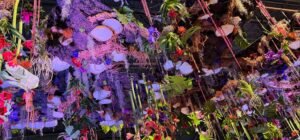 Every Travel Tuesday, I look for the kind of trip that gives back more than it takes. This one delivered.
I wasn’t even in Philadelphia for 24 hours.
I flew in on a Friday night, walked into the Pennsylvania Convention Center early Saturday morning for the 2026 Philadelphia Flower Show with my Sony camera, and could smell the flowers before I saw a single bloom. That fragrance, layered and warm, soil and stems and something sweet you can’t quite name, drifted through the corridor and found me before I even turned the corner.
That moment, a sensory experience that arrived before any visual did, is one of the most important lessons in brand experience design I’ve encountered anywhere in the world.
Your brand reaches people before they see you. Before they read your headline. Before they hear your keynote. The question is: what are you sending ahead of yourself?
I’ve spent years helping associations, speakers, and B2B brands build visibility strategies and brand experiences that stick. I speak on AI literacy, human storytelling, and the future of PR and communications. And one truth keeps surfacing in every keynote and every strategy session:
The most powerful brand experiences are the ones rooted in something real.
No algorithm can manufacture that. No AI tool can replicate it. And no show in the world makes that clearer than the Philadelphia Flower Show.
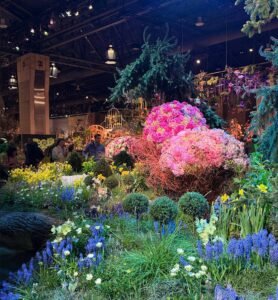
Brand Experience Begins Before You Walk In
The Philadelphia Flower Show is one of the most sophisticated brand experience laboratories in the world, and most people don’t think of it that way.
Every element is intentional. The fragrance in the hallway. The theatrical lighting on each installation. The quiet of early entry before the crowds arrive. The way each garden is framed as its own story, with a title, a designer credit, and a narrative placard that gives you context before you even look up.
This is what I talk about when I speak on brand experience: the experience begins at the edges, not at the center.
For associations, it begins before registration opens. For events, it begins before the doors do. For speakers, it begins before you step on stage. For brands, it begins in the search result, the social post, the word of mouth, and yes, sometimes the fragrance in the hallway.
For the second year in a row, I booked the early-entry photography tour at the PHS Philadelphia Flower Show, themed Rooted: Origins of American Gardening. I came with my Sony camera and spent those early-morning hours doing what I love: finding the story inside the frame.
Every photo in this post is my original work, captured before the public doors opened.
As a speaker and strategist who covers events through both a communications lens and a visual one, I believe the image you lead with says as much about your brand as any headline. Photography is not a hobby for me. It’s a strategic lens. It’s how I document brand experience in real time, looking for the moments that tell the whole story in a single frame.
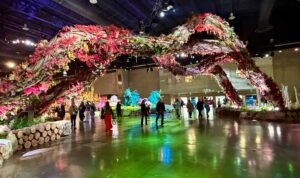
At one point I walked under an arch completely covered in flowers and thought:
This is what a fully bloomed brand experience feels like in real life.
Philadelphia: Where American Botanical Storytelling Began
Philadelphia’s botanical roots run deeper than the show floor suggests, and knowing that context makes every installation richer.
Long before this show existed, French botanist André Michaux traveled through Philadelphia, collaborating with William Bartram at what is now Bartram’s Garden, the oldest surviving botanical garden in North America, founded in 1728 along the Schuylkill River. I first read about Michaux in The Scientist Turned Spy, a fascinating study of how botanical exploration and international diplomacy overlapped in early America.
The 2026 theme, Rooted: Origins of American Gardening, honors that heritage as the final chapter of a three-year PHS series, arriving precisely as the U.S. marks 250 years. Every installation felt like a chapter in a longer story about where we come from and what we carry forward.
That’s the question at the heart of every great brand story too:
What are you rooted in, and is your brand telling that story clearly enough for the right people to find you?
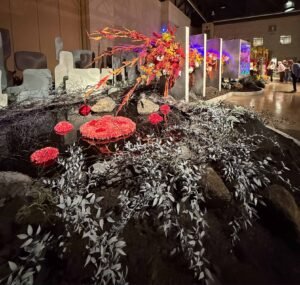
Storytelling in Full Bloom: 2026 Show Highlights
The show runs February 28 through March 8, 2026, at the Pennsylvania Convention Center. It’s enormous, layered, and designed to reward people who slow down. Here are the installations that stopped me and made me reach for my camera, along with what each one teaches about brand experience and storytelling.
For Sale: This Beautiful Home and Garden by Kelly D. Norris framed a native-plant garden as a real-estate listing. The storytelling device was brilliant: a familiar format (for sale sign, listing details) made an unfamiliar idea (native plants as aspirational landscaping) instantly accessible. Lesson: Use familiar frameworks to introduce unfamiliar ideas.
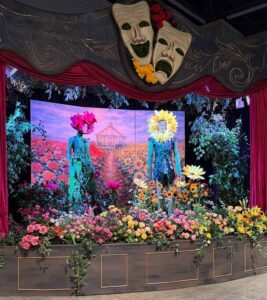
Rooted in Love by Jennifer Designs staged the language of flowers as a full theatrical production, with velvet curtains, floral couture figures wearing giant blooms as headpieces, and a Bloombill placard listing the cast and crew. As someone who thinks about narrative architecture constantly, this one was deeply satisfying. Lesson: Commit fully to your metaphor. Half-told stories don’t land.
The Orchid Kingdom by Waldor Orchids honored orchid varieties named for First Ladies, weaving botanical history and cultural diplomacy into one breathtaking display. Lesson: Connect your story to a larger cultural narrative and your audience grows.
Ikechi presented two Black hands cradling an abundance of flowers, honoring African American contributions to American horticulture, with cotton plants at its base. It carried quiet, deep power. Lesson: The most resonant brand stories honor what came before.
Sparks Fly in Franklin’s Garden reimagined a colonial-era garden where Franklin might have flown his famous kite, built entirely from miniature ficuses and pilea plants. Lesson: Scale doesn’t determine impact. Specificity does.
What Photography Taught Me About Brand Storytelling
Photography is how I process brand experience in real time.
You can pull back and capture the whole production, thousands of blooms at different heights, depths, and colors, all timed to peak at exactly this moment. Or you can zoom in on a single blossom and find an entirely different world inside it.
Both are true. Both are necessary.
This is the tension at the heart of great brand storytelling too. You need the wide frame, the brand vision, the event theme, the campaign arc, and the close-up, the one detail that makes a person stop scrolling, lean in, and feel something.
The photographers I spoke with on the tour had spent years studying this show. They knew which angles worked, where the light fell best, and which installations rewarded patience. Their generosity reminded me of something I say in every keynote:
The best brand storytellers are generous. They share what they know because they understand that a rising tide lifts all boats.
A Flower Shop, a Hill, and the Origin of My Brand Story
People often ask me why flowers appear so consistently in my work. Why Friday Flowers every week? Why fly somewhere for less than a day just to walk through a hall of blooms?
When I was young and as I grew up, my mom faced serious health challenges. Back then, when I wanted to bring some light into our house, I’d gather whatever coins I could find, maybe a dollar or two, and walk up a big hill to our neighborhood flower shop.
I’d always stop at the window first, just looking at all things green and growing. Then I’d step inside and get wrapped up in that scent: soil, stems, and an essence you can’t name.
The florists would bundle up cuttings from finished arrangements and send me home with an armful of beauty. Those castoff bouquets didn’t change her diagnosis. But they brightened our days.
That experience is the root of my brand story. It’s why I talk about beauty as a strategy. It’s why I believe that the most powerful marketing is the kind that makes someone feel less alone. It’s why I flew to Philadelphia for less than 24 hours just to be inside a room full of flowers.
Beauty is strategy. Beauty is medicine. Beauty is PR for the soul.
This is also what I teach leaders and communicators: your brand origin story is not decoration. It’s the root system everything else grows from.
The Path to PR: Florist, Writer, Strategist, Speaker
In college, I took two floral design classes and fell in love with ikebana, the Japanese art of mindful arrangement where negative space matters as much as the bloom itself. Later I became a national sales trainer. I loved the work, but the travel rhythm didn’t match the life I wanted with a little one at home.
Career counseling presented me with two paths: florist or writer.
I looked seriously at the florist path. But the hourly rate wouldn’t cover the babysitter. So I chose the pen instead.
First with a story about my grandmother’s garden that caught the attention of the Chicago Tribune
Then with PR, content, and campaigns for clients across home design, associations, B2B, and B2C
Eventually with landscape architects, crafting award-winning contest entries and press coverage for their gold medal wins
And now as a Fractional CMO, strategic analyst, and keynote speaker helping associations, event professionals, and B2B brands build brand experiences and visibility strategies that last
Although I don’t design gardens, I design how people experience them through words, strategy, story, and image.
What AI Has to Do With Brand Experience and Storytelling
As someone who speaks on AI literacy and the future of visibility, I find the Flower Show a powerful reminder of something I say on every stage:
AI can generate content. It can’t generate context.
AI can write a description of a floral arch. It can’t walk up a hill to a flower shop with a dollar in its pocket. It can’t feel the fragrance drift through a corridor before a single bloom comes into view. It can’t carry decades of memory into a convention center on a Saturday morning and translate that into original photography and strategic insight.
In a world where AI is producing more content faster than ever, the brands, speakers, and organizations that stand out are the ones who say: this story is mine and no one else can tell it.
That’s the root system no algorithm can replicate.
When I work with clients on AI visibility strategy, the starting point is always the same: what is the lived experience, the genuine expertise, the human story that only you can bring? Build that clearly first. Then use AI to amplify it, not replace it.
That’s the difference between content that ranks and content that resonates.
The Splash Moment: Brand Experience Design in Action
Walking through the 2026 show, I kept thinking about how much design, art, construction, and care hides behind each installation.
Students and designers pull long days. Trucks of plant material arrive on precise schedules. Structures go from almost nothing to breathtaking in what feels like overnight. One tour guide pointed to a college-built tribute exhibit and said it looked like almost nothing just hours before the doors opened. Then it all came together.
And in a few days, it would be gone.
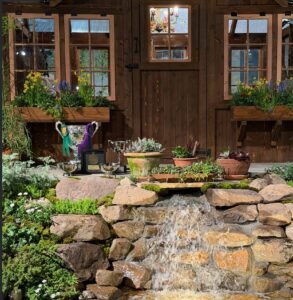
That’s the splash moment.
Months of planning, hundreds of decisions, and extraordinary human effort all accumulate into one vivid, irreplaceable window of time. An opening session. An awards night. A trade show floor. A floral arch that takes your breath away even though you know it won’t be there next week.
This is the essence of brand experience design: everything leads to one moment when the audience feels exactly what you intended them to feel. You design that moment on purpose or you leave it to chance.
Our work, as event planners, association leaders, speakers, PR professionals, and brand strategists, is to design those splash moments on purpose, every single time.
The Four-Season Visibility and Brand Growth Framework
Flowers and gardens run on seasons. So do brands, visibility strategies, speaking careers, and brand experiences.
Here’s the framework I bring to keynotes and strategy sessions with association leaders, event professionals, and B2B communicators. I call it the Brand Visibility Growth Cycle.
Winter: Quiet Strategy and Root Work
Roots deepen even though nothing is visible above the soil. This is your research season: positioning, message clarity, audience mapping, brand story refinement, and ICP analysis. It feels slow. It’s the most important work you’ll do.
Brand experience application: This is where you ask, “What do we want people to feel at every touchpoint?” before you design a single event element or publish a single piece of content.
Speaker application: Refine your signature talk. Clarify your niche. Build relationships before you need them.
Spring: Planting and First Shoots
You start sharing your story. Pitches go out. Content gets posted consistently. You speak on smaller stages. You pilot new experiences and nurture early relationships.
Association application: Member communications, media outreach, and event promotion begin. This is where brand storytelling is most critical and most underinvested.
Brand experience note: Spring is when your audience forms their first impressions. Every touchpoint, from your email signature to your event invitation design, is a brand experience moment.
Summer: Full-Bloom Visibility and the Splash Moment
This is your Philadelphia Flower Show moment. Your conference is buzzing. Your keynote lands. Your campaign gets coverage. Your brand experience is firing on every cylinder.
AI application: This is when your AI-optimized, EEAT-rich content generates compounding organic reach, because the root system (winter) and the cultivation (spring) made it possible.
Brand storytelling note: Summer is when your best stories get told by others. Design your experiences so people have something worth sharing.
Fall: Harvest, Reflection, and Compost
You collect testimonials, photos, metrics, press clips, and stories. You study what worked and what didn’t. You make decisions about what to repeat, refine, or retire.
Brand experience note: Fall is when your post-event surveys, member feedback, and media coverage tell you whether your intended experience matched your audience’s actual experience. That gap is where next year’s strategy lives.
When I speak to association and B2B audiences, I start here: not with tactics, but with seasons.
What’s your stage of growth? What does your root system look like? What splash moment are you designing toward?
That conversation changes everything.
Friday Flowers: A Weekly Brand Experience Moment
One reason I love living in North Carolina is the extended bloom time: camellias in winter, gardenias and magnolias in the warmer months. The year feels punctuated by petals.
Every Friday I share Friday Flowers with my community. It doesn’t always get big numbers. That’s not the point.
It’s a brand experience moment: small, dependable, sensory, and human. A signal that beauty is still here and that your week deserves at least one moment of color.
In a world that can feel dominated by urgency and noise, this is my brand choice. I keep walking up the virtual hill to the flower shop and bringing back something beautiful to share.
The Philadelphia Flower Show reminds me every year why those small, consistent, human moments are the ones that root a brand in people’s memories.
What This Means for You
Association and event leaders: Your brand experience begins before registration opens and extends long after the last session ends. Design every touchpoint intentionally, especially the fragrance in the hallway, the moment before people see the main event.
Speakers and thought leaders: Your origin story is your root system. The flower shop at the top of the hill, the reason you do what you do, is what makes your brand experience uniquely yours and impossible to replicate with AI.
PR and marketing professionals: Think in seasons and design for splash moments. Stop expecting summer-level results from spring-stage efforts. And invest in the brand story that anchors everything else.
Anyone exploring AI and brand visibility: Build your human story first. Build it clearly, specifically, and with the kind of sensory and emotional detail that only lived experience can provide. Then use AI to amplify it. That’s the sequence that works.
Looking Ahead: From Philadelphia to Kew
The Philadelphia Flower Show is now on my annual calendar as a creative reset, a brand experience laboratory, and a strategy session wrapped in petals.
Next up: the Orchid Festival at Kew Gardens in London. Two continents, two extraordinary brand experiences, one through-line: roots, resilience, and the courage to keep blooming even when the season feels uncertain.
If you’re looking for a keynote speaker who connects AI literacy, brand experience, human storytelling, and visibility strategy for your association, conference, or corporate event, let’s talk.
If you’d like a seasonal brand visibility roadmap for your organization, I’d love to explore that with you.
Connect with me here or explore speaking and strategy options.
What season is your brand in right now: winter, spring, summer, or fall?
Leave a comment below and let’s grow something together.
FAQ
Who is Barbara Rozgonyi and what does she speak on?
Barbara Rozgonyi is a PR and visibility strategist, AI keynote speaker, brand experience consultant, photographer, and founder of CoryWest Media and WiredPRWorks. She speaks on AI literacy and narrative strategy, brand experience design, visibility and personal branding, PR strategy for associations and B2B brands, and the human story advantage in an AI-saturated world.
What is brand experience design and why does it matter?
Brand experience design is the intentional shaping of every touchpoint an audience has with your brand, from the first impression to the lasting memory. It matters because audiences remember how you made them feel long after they forget what you said. The Philadelphia Flower Show is a masterclass in brand experience: every element, from fragrance to lighting to storytelling placards, is intentional.
What is the difference between content and brand storytelling?
Content fills space. Brand storytelling fills meaning. Content can be generated by AI. Brand storytelling requires lived experience, genuine expertise, and a root system that only comes from the human story behind the brand. Barbara teaches audiences how to build that root system first and then use AI to amplify it.
What is the four-season brand visibility growth framework?
The four-season framework maps brand and event growth to seasonal cycles: Winter (quiet strategy and root work), Spring (first outreach and content planting), Summer (full-bloom visibility and splash moments), and Fall (harvest, reflection, and planning for next season). It helps leaders align their tactics with their true stage of growth and stop expecting summer results from spring-stage efforts.
How can I book Barbara Rozgonyi to speak at my association or event?
Visit [link to speaker page] to explore topics, watch video clips, and connect about availability for your next association conference, corporate event, or professional development program.
What is Friday Flowers?
Friday Flowers is a weekly social media tradition by Barbara Rozgonyi in which she shares an original photograph and reflection on a single flower, offering her community a weekly brand experience moment: small, human, sensory, and consistent.
About Barbara Rozgonyi
Barbara Rozgonyi is a PR and visibility strategist, AI keynote speaker, brand experience consultant, photographer, and founder of CoryWest Media and WiredPRWorks. She helps associations, event organizers, and B2B brands design standout brand experiences, stories, and campaigns that create lasting visibility. A former national sales trainer and lifelong flower lover, she blends data, creativity, and narrative to turn leaders into visible, in-demand voices. She is a member of NSA Carolinas and the Charlotte Garden Club and speaks regularly on AI literacy, brand experience, personal branding, PR strategy, and photography.
All photographs in this article are original work by Barbara Rozgonyi, captured at the 2026 Philadelphia Flower Show.
This article was drafted with the assistance of AI tools and reviewed, edited, and enriched with original photography and firsthand experience by Barbara Rozgonyi.