
 If you’ve ever done something your whole career without calling it what it is, this one’s for you.
Chicago has a way of doing this to me. I go back for one reason, and the city surprises me with another.
In April, I was in town for Brandsmart. While I was packing, I pinned a small writer pin onto my jacket, one I picked up at Keats House in England. I wore it because I liked it. It wasn’t trying to make a statement. But by the end of the day, it felt like one.
That same trip, I finally made it to the American Writers Museum on Michigan Avenue, and it turned out to be one of the best things I did all week. It’d been on my Chicago must-do list for a while, and I kept putting it off. Sometimes the places we most need to visit are the ones we keep postponing.
What Is the American Writers Museum?
The American Writers Museum is located at 180 N. Michigan Avenue in Chicago, right in the heart of the Loop, steps from Millennium Park. It’s the only museum in the United States dedicated to celebrating the writers who have shaped American culture, history, and identity.
The museum features rotating and permanent exhibits spanning fiction, poetry, journalism, and more, with immersive installations, iconic typewriters, author banners, an interactive bookshelf, and artifacts from some of the most influential American voices across every era.
It’s not a quiet archive. It’s a living conversation about why writing matters.
If you’re visiting Chicago, or you live there and haven’t gone yet, put it on your list. Admission is affordable, the exhibits are walkable in about two hours, and you will leave thinking about your own story.
Take It Easy. But Take It.
One of the first people I thought about when I walked in was Studs Terkel.
On one of my very first dates with my husband, back when he was my boyfriend, we went to hear Studs at an author talk. Afterward, we waited to meet him. Studs looked at us and said six words I’ll always remember:
Take it easy. But take it.
Seeing his banner at the museum brought all of that back. The exhibit describes Studs as an oral historian with a tape recorder who spent his life searching out the thoughts of ordinary people. For years, I heard his words as life advice. Standing there, I understood something else: it’s creative advice too. Take what’s yours. Don’t leave it sitting on the table.
Walking Through My Own Timeline
Wandering the galleries felt like browsing earlier chapters of my own story.
L. Frank Baum took me back to my work in the Fine Arts Building on Michigan Avenue, the same building where he had his office. I taught brand design for creatives there. As a girl, I played Glinda the Good Witch. The museum notes that the Emerald City might be a fantasy version of Chicago. Standing there, I realized some threads in a life only make sense when you’re far enough along to see the pattern.
“So I believe that dreams—day dreams, you know, with your eyes wide open and your brain machinery whizzing—are likely to lead to the betterment of the world.”
Jane Addams was there too. I worked on a writing project highlighting the Jane Addams College of Social Work, whose tagline was Give a Damn. I’ve walked through Hull House. Her commitment to showing up and documenting it has always stayed with me.
“The good we secure for ourselves is precarious and uncertain until it is secured for all of us and incorporated into our common life.”
Gwendolyn Brooks offered a warning that feels more timely every year:
“Truth-tellers are not always palatable. There is a preference for candy bars.”
In PR and visibility work, I think about that tension all the time. Easy content gets clicks. Honest content builds trust.
Roger Ebert, a fellow U of I alum, reminded us:
“We must somehow dream.”
My husband and I went to Ebertfest in Champaign last year. I grew up watching Siskel and Ebert on PBS and loved the way they argued about movies with such precision and genuine love for the form. Seeing his banner felt like a nod from a familiar face.
When I was growing up on Chicago Avenue, I asked my parents to subscribe to the Chicago Daily News. I always looked forward to reading Mike Royko’s column. He wrote more than 7,500 columns and won a Pulitzer in 1972 for writing about Chicago the way its people like to think of themselves: tough, cynical, humorous, and with compassion for the little guy.
And of course, Abraham Lincoln was there with a quote from Ted Sorenson calling him the best of all presidential speechwriters. A president, yes, but also the best writer in the room.
Finding the Words
Then there were the typewriters.
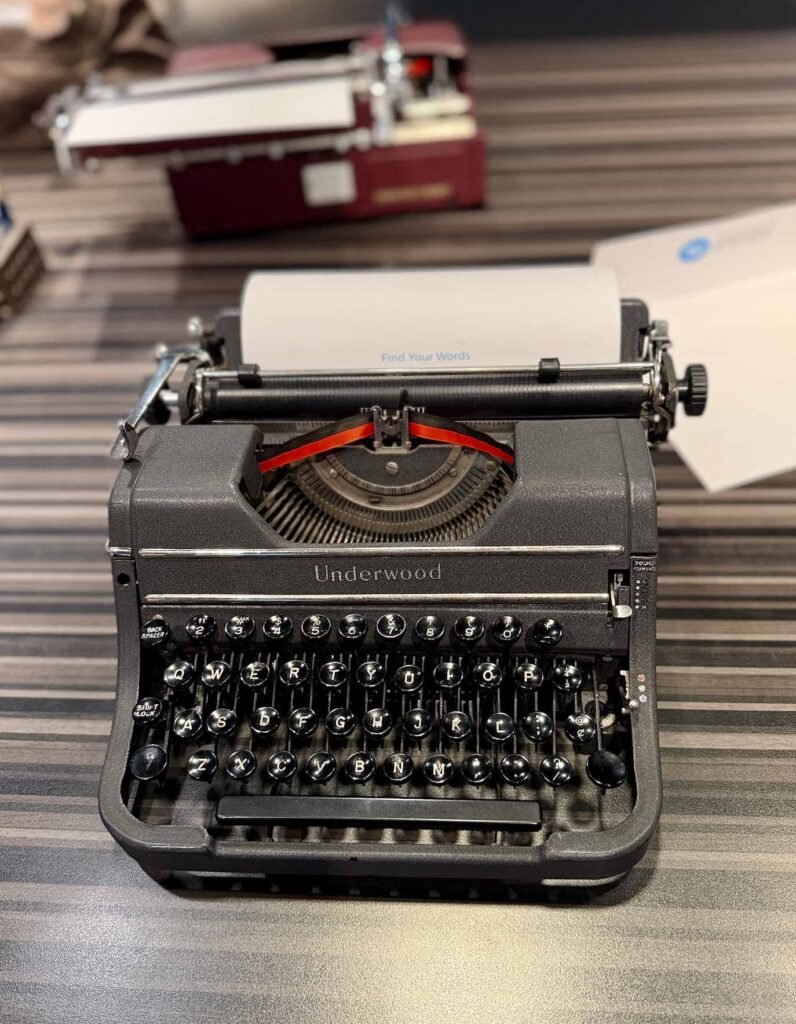
I stood looking at a beautiful old Underwood with a page loaded in the carriage that simply read: Find Your Words.
I always wanted my own typewriter, but I never had one. In college, I asked my professors if I could turn in handwritten drafts. Then, I’d drive 35 miles to Danville to type my papers at Aunt Aggie’s house before delivering the typed pages. A few professors raised their eyebrows, but they all accepted my final drafts.
Standing in the museum, I realized: finding your words has always been the assignment. The tools change. The assignment doesn’t.
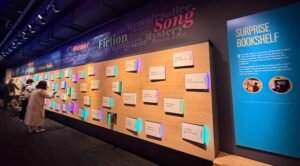
Before I left, I explored the Surprise Bookshelf, an interactive wall with insights from 100 works across dozens of writing categories. Playful, unexpected, and brilliant. It’s the kind of thing you’ll spend more time with than you planned.
The Book That Kept Me Thinking
After the trip, I found myself back with letters.
When Ann Patchett recommends a book, I put it at the top of my reading list. She recently recommended The Correspondent by Virginia Evans, so I put my name on the hold list at Charlotte Mecklenburg Library and waited. When I finally reached the top, I went to pick it up. I was one day late. The hold had expired. The book was back out in circulation.
When I asked where I was in line, they told me I’d gone from first to 1,142.
I’m reading a neighbor’s copy now, and my own copy is waiting for me at a local bookstore.
Because The Correspondent is about letter-writing, it brought me right back to college.
The Letter That Changed Something
My business and technical writing professor at the University of Illinois gave us an assignment: write letters to people and see what happens.
So I did.
After I bought my first car, I got a letter from the CEO of Ford thanking Mr. Rozgonyi for the purchase. I was offended. I bought that car myself, and I was proud of it. So I wrote him back to let him know: women are buying cars now.
I did get a letter back with an apology and a proper congratulations.
The Job I Turned Down
That professor saw me as a writer long before I called myself a writer. He recommended me as his top student for a corporate communications position in Chicago after graduation.
I turned it down. Why?
Because I wanted to go into sales. Writing felt too quiet to build a life around. Sales had energy. I chased that instead.
Less than ten years later, I founded CoryWest Media, a marketing and communications practice built on, of all things, writing.
I went on to write for Sears, Roebuck and Co., including authoring the I Am Sears cover story. It came out of a companywide initiative called Take Me to Your Leader, where we asked 300,000-plus associates to nominate someone who best exemplified the company’s values. My job was to interview the nominees and the people who had nominated them, and then write their stories. To this day, it’s one of the most meaningful projects I’ve ever done. You sit with someone who truly embodies something worth celebrating, and you find the words. That’s writing as a gift.
About five years later, I mentioned that piece in a meeting. The woman across from me said she knew it.
“It was required reading for every Sears manager.”
I had no idea. That’s the part I still love about writing and what I tell every client working on their visibility: your writing goes places you never see.
What Writers Know
Ann Handley says everybody writes. She means it literally: emails, LinkedIn posts, proposals, keynotes, texts. You’re already writing every day. The question is whether you’re doing it with intention.
Here’s what the American Writers Museum reminded me, and what applies to anyone building a personal brand or a public presence:
Your specific stories are your best content. Not your frameworks. Not your bullet points. The letter to the Ford CEO. The drive to Danville. The article that became required reading. Nobody else has those.
You don’t need a bigger story. Mike Royko wrote about the city outside his window. That was enough. Your history and your people are more than enough.
Truth is a visibility strategy. Gwendolyn Brooks was right about the candy bars. Easy content moves fast and disappears just as fast. Honest content is what gets shared a year later.
A letter can still change a mind. Before DMs, before email, before viral posts, a well-written letter moved the needle. It still does.
Your writing goes places you never see. Required reading for 300,000 managers. A contest win. A cover story. You write it once and it keeps going. That’s the compounding power of putting words into the world with intention.
So this post is partly Chicago travel, partly a museum review, and partly about what happens when a place reflects you back to yourself.
Go if you love books and storytelling. Go if you’re curious about the writers who shaped this city and this country. Go if you’ve ever had the feeling that something essential about you has been obvious to other people long before it was obvious to you.
That was the real gift of this visit. Not that I discovered something new. I finally claimed something old.
I am a writer. I always was.
Take it easy. But take it.
Plan Your Visit
American Writers Museum
180 N. Michigan Avenue, Chicago, IL 60601
americanwritersmuseum.org
Open Tuesday–Sunday | Steps from Millennium Park | Accessible via the Red, Blue, and Brown Lines
Currently Reading: The Correspondent by Virginia Evans — Ann Patchett approved. Good luck getting it from the library on time.
What have you been doing your whole career that you’re finally ready to own? Tell me in the comments.
About Barbara Rozgonyi
Barbara Rozgonyi is a keynote speaker, PR/AI visibility strategist, podcaster, photographer, and digital creator. As the founder of CoryWest Media, she helps executives, thought leaders, and brands show up with clarity, confidence, and a brighter presence. Connect at barbararozgonyi.com.
A note on this post: Every story here is mine. I use AI the way I’d use a great editor: to help organize my thoughts, sharpen the pacing, and catch what I’m too close to see. The words, the Chicago history, and the truth of the experience are entirely mine.

