
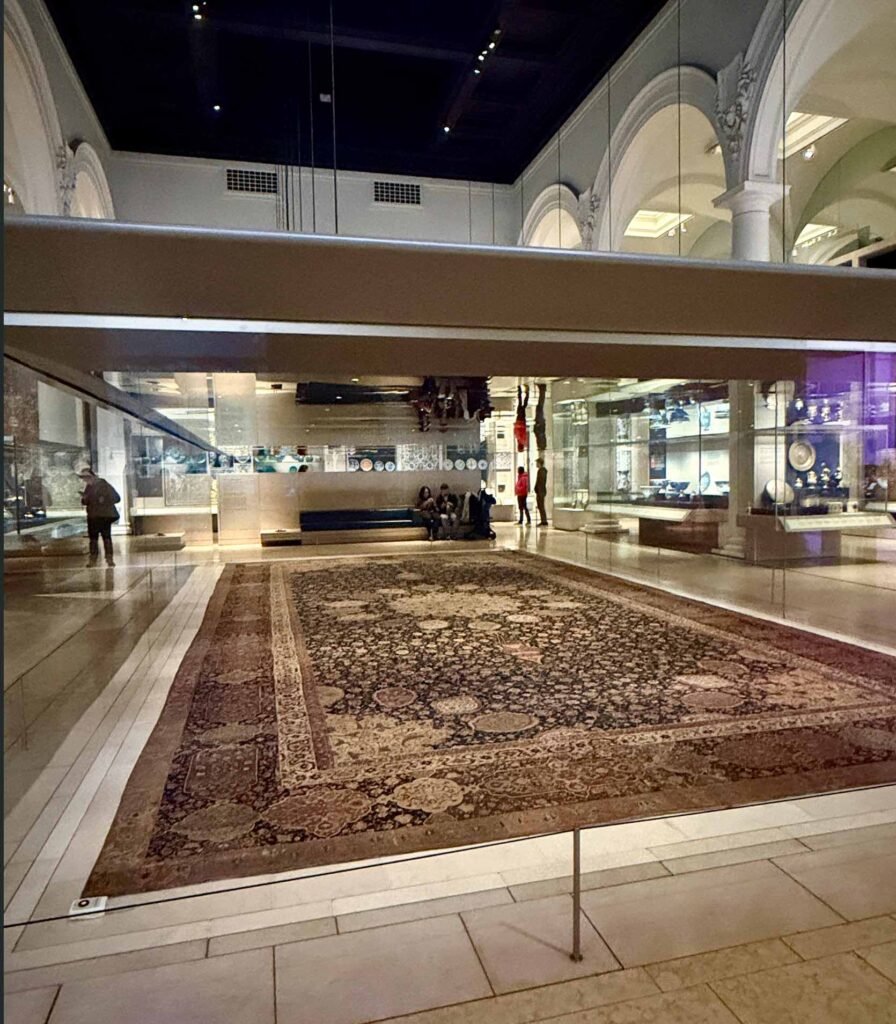
 For three days in London, I kept returning to the same room at the Victoria and Albert Museum.
Not for a famous painting. Not for a royal artifact.
For a carpet.
Travel Tuesday takes us to see the Ardabil Carpet, which is a masterpiece of Islamic art and one of the largest, oldest, and most historically significant Persian carpets in existence. Woven during the golden age of Persian carpet making under the Safavid dynasty in 1539–1540, it fills an entire gallery with astonishing color, symbolism, and geometry.
But there’s something else unusual about it. To preserve its richness and protect its centuries-old dyes, the museum only illuminates it for ten minutes every hour and half hour.
So, I found myself timing my visits around those brief windows of light. Every day, I walked across the street from our hotel to sit quietly in the gallery and watch the carpet emerge from the darkness. And every time, I noticed something new.
The Art Beneath Our Feet
As I sat there, groups of visitors drifted in and out. A German tour group. Students. Museum lovers.
Some people snapped photos and moved on. Others stayed.
The longer you looked, the more the magnificent scale and detail of the carpet revealed itself. Measuring an astonishing 34 feet 3 inches by 17 feet 6 inches, the entire surface is covered by a single, perfectly integrated design.
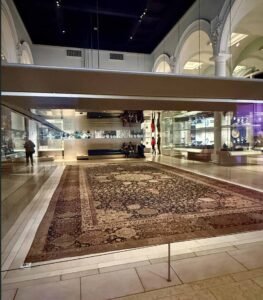
At its center is a massive yellow sunburst medallion, surrounded by 16 radiating pointed oval shapes designed to represent the inside of a dome—symbolizing the celestial vault and the divine. The borders are filled with intricate scrollwork, including the mahi (fish) design symbolizing fertility and good luck, and the lachak-o-bazuband (spiral and armlet) design representing unity and eternity.
Then, there are the staggering numbers behind its creation.
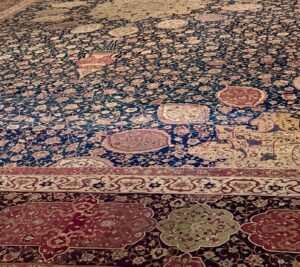
The carpet is composed of a silk foundation with a wool pile, chosen because wool holds dye better than silk. The knot density is exceptionally high, around 5,300 knots per ten centimeters square. This translates to roughly 26 million individual knots.
To achieve this, it is estimated that a team of up to ten highly skilled weavers worked simultaneously for several years. They used natural materials, like pomegranate rind for yellow and indigo for blue, creating a subtle color-shifting “ripple” effect across the wool.
Yet, as magnificent as the carpet is, my mind kept returning not to the Safavid rulers who commissioned it, but to the artisans who created it. What did it feel like to sit for years tying 26 million knots, never knowing whether strangers from around the world would one day gather in quiet reverence around something your hands made?
The Ardabil Carpet at the V and A Museum
Threads of Empire and the Invisible Makers
Before visiting the exhibit, I began reading Threads of Empire: A History of the World in Twelve Carpets by Dorothy Armstrong.
“[Threads of Empire] displays deep learning, endless curiosity—and a conviction that seemingly mute objects can be anything but.” — The Wall Street Journal
The book reframes carpets not just as decorative objects, but as silent witnesses to history. Armstrong reveals how great carpets follow power—craved by emperors, shahs, and sultans as symbols of earthly domination, and stood upon by world leaders during moments that shaped history.
The Ardabil Carpet itself is a survivor. Originally, it was one of two identical carpets placed in the shrine of Shaykh Safi al-Din. In the 1870s, after the shrine suffered earthquake damage, both carpets were sold to a Manchester firm. The firm used parts of the smaller carpet to repair the larger one, piecing together a singular, perfect masterpiece from the ruins.
But Armstrong continually redirects our attention back to the weavers. the invisible hands making world-shaping objects using millennia-old skills.
Their invisible presence has power. Because in many ways, we’re living through a similar moment now. We celebrate platforms, algorithms, AI tools, and viral visibility. But beneath all of the digital empires we’re building, human craftsmanship still matters.
What the Ardabil Carpet Teaches Us About Leadership in an AI World
As someone who guides executives, CMOs, association leaders, meeting planners, and thought leaders on visibility in the AI era, I left the gallery thinking about a difficult question: What kind of work will still matter 500, or even 5, years from now?
What endures? The Ardabil Carpet offers unexpected answers.
1. Enduring visibility is woven slowly (For CMOs & Thought Leaders)
Great reputations aren’t manufactured overnight. They’re woven thread by thread through consistency, creativity, trust, and meaning. We know exactly when the Ardabil carpet was finished because of an inscription woven into the edge, featuring a poem by Hafiz Shirazi and the signature of Maqsud Kashani, the court official in charge of its production. In an era obsessed with speed, the carpet reminds us that some of the most important work requires immense patience. For CMOs and thought leaders, this means developing brand ideas worthy of returning to, not simply reacting to the algorithm of the day.
2. Imperfection makes work human
One detail of the carpet fascinated me: the two hanging pendant lamps woven into the design are intentionally different sizes. Some art historians argue this was done to create a forced perspective for whoever sat on the carpet. Others believe it is a deliberate flaw, reflecting the Islamic belief that perfection belongs only to God. Either way, the carpet resists machine-like sameness. Right now, much of our digital content feels frictionless, polished, optimized, and strangely forgettable. The work that resonates most deeply retains signs of humanity: texture, vulnerability, asymmetry, and fingerprints.
3. Not everything valuable should be exposed constantly (For Association Executives)
I cannot stop thinking about the museum’s lighting schedule. Ten minutes per hour. That’s it. Visibility without preservation eventually destroys richness. We live in a culture that rewards perpetual exposure and algorithmic exhaustion. But perhaps leaders and association builders should think more carefully about protecting what gives their communities depth: reflection, strategic thinking, and quiet connection. The brightest presence is not always the loudest one.
4. The power of the pause (For Meeting Planners & Event Strategists)
What moved me most wasn’t just the carpet itself—it was watching people stop. In a distracted world, creating a meaningful pause is a profound form of leadership. Meeting and event planners understand this instinctively. The best conferences are not just information delivery systems; they create environments that foster reflection, emotion, and connection.
William Morris Was Right
When the complete Ardabil Carpet was put up for sale in London in 1892, the legendary designer William Morris was sent to inspect it on behalf of the V&A Museum.
He reported that the carpet was “of singular perfection… logically and consistently beautiful.” Recognizing its immense cultural value, he urged the museum to raise the funds to buy it, writing:
“I think it would be a real misfortune if such a treasure of decorative art were not acquired for the public.”
Morris himself was responding to the Industrial Revolution and the growing mechanization of creativity. He understood that mass production was threatening the soul of design, and he fought to preserve this masterpiece so that future generations could experience true human craftsmanship.
Today, we are navigating a different revolution, but many of the same questions remain.
As AI transforms communication, marketing, and content creation, the leaders who stand out may not be those who produce the fastest or the most. They will be the ones who create work with soul, texture, and emotional resonance. The ones who create work that would be a “misfortune” to lose.
As I left the gallery one final time, I thought about the unnamed weavers. Their 26 million knots survived earthquakes, political upheaval, and centuries of history. In a world accelerating toward automation, maybe our greatest opportunity isn’t simply to become more visible. Maybe it is to create something worth returning to.
Something woven with care. Something human. Something that still glows, even centuries later.
Author’s Note: The core story, insights, and terrible museum lighting timing are 100% human. AI was used strictly as a collaborative editor to refine the structure and format.
Barbara Rozgonyi is a strategic marketing and PR leader, keynote speaker, and visibility consultant who helps executives, CMOs, association leaders, and thought leaders build trust, influence, and enduring presence in the AI era. Through keynotes, workshops, consulting, and content, she brings together brand strategy, communications insight, and a human-centered approach to visibility that empowers brands and leaders to stand out with a Brighter Presence around clarity, credibility, and meaning.

