Chicago Leadership Lessons: What Ferris Bueller Teaches Us About Visibility
Travel Tuesday | Ferris Bueller’s Day Off 40th Anniversary
By Barbara Rozgonyi | barbararozgonyi.com
If you haven’t stopped and looked around yet today, this post is for you, especially if you’re a leader, executive, or expert doing remarkable work and not getting the recognition it deserves. The answer usually isn’t more content. It’s more observation. Ready? Let’s go to Chicago.
My husband proposed with a question: “Do you want to get married and live in a Greystone in Wrigleyville?”
I said yes. And that’s exactly what we did at 3740 N. Magnolia, near Clark and Grace.
So when Ferris Bueller’s Day Off opened in theaters, I was living near the Friendly Confines, commuting downtown to my office at 676 N. St. Clair, stepping off the Red Line in my dressy work clothes and walking straight through a cheerful gauntlet of Cubs fans always waving me in for a beer on game days. I waved back as I kept walking and laughing. It was that kind of neighborhood. Chicago makes you feel like you belong in the scene even when you’re just passing through. Like when we stopped for a burger and a beer at Murphy’s Bleachers last November.
Forty years after the film’s release on June 11, 1986, I keep coming back to this city. And every time I do, Chicago reminds me of something I forgot I knew. We still have family, friends, favorite places, and decades of memories in Chicago, which gives us plenty of reasons to return.
Ferris Wasn’t Avoiding Life. He Was Paying Attention.
John Hughes wrote the Ferris Bueller’s Day Off screenplay in less than a week. He said Chicago itself was the real co-author: “I really wanted to capture as much of Chicago as I could. Not just in the architecture and landscape, but the spirit.”
Ferris spent his famous day visiting the Art Institute of Chicago, the Sears Tower, Wrigley Field’s bleachers, and the Von Steuben Day Parade on State Street where 10,000 Chicagoans showed up simply because radio stations announced a John Hughes film was shooting downtown. He turned around mid-song and saw a river of people.
Ferris wasn’t avoiding his classes or his life. He was paying close attention to everything.
If you lead a team, run an organization, or build a brand, this is the post for you. The leaders I work with who struggle most with visibility are not invisible because they lack talent or ideas. They’re invisible because they have stopped noticing. Chicago, and Ferris Bueller, have something to say about that.
That’s one reason I believe visibility begins with observation. The leaders, brands, and organizations that stand out aren’t always the loudest. They’re usually the ones paying closer attention than everyone else.
The Art Institute Scene Nobody Gets Right
As Cameron stands in front of Georges Seurat’s A Sunday Afternoon on the Island of La Grande Jatte and zooms in closer and closer until the individual dots dissolve into abstraction, he’s searching for his identity. The closer he looks, the less he can see.
Hughes called it “a self-indulgent scene, a place of refuge for me.” The Art Institute of Chicago had never been filmed before Hughes approached them. Ferris and Sloane share a quiet moment in front of Marc Chagall’s America Windows in the same museum. The film was selected for preservation in the U.S. National Film Registry in 2014, deemed culturally, historically, and aesthetically significant, and it has more works of art in it than almost any other film of its era.
The leadership lesson is this: sometimes you’re so close to what you’re building that you lose the picture entirely. The strategy, the brand, the team: it all dissolves into dots. You need a different room. You need distance. You need Chicago.
I’ve been going to the Art Institute for decades. The first time was when I came to Chicago as a college student for a career fair. When we lived in Glen Ellyn, we were members for years. A neighbor of mine here in North Carolina went back to Chicago with her daughter just to pop in. They changed their entire plans and returned every single day for three straight days. There’s that much to see. And that much to feel.
When did you last step back far enough to see the whole picture?
The Energy of Possibility
I grew up on a street called Chicago Avenue, not the one in the city I love. Mine was about 120 miles south. But Chicago was always the destination, always the word that meant something bigger was possible.
Looking back, I don’t think I miss Chicago because of the buildings.
I miss the energy of possibility Chicago gave me at a particular stage of my life, and the way it made me believe that what I was building deserved a bigger room.
Chicago taught me that big ideas belong in big rooms. That architecture is a declaration of what a city believes it deserves. That creativity belongs in public spaces, not just boardrooms. A city can physically expand your sense of what you’re capable of.
Charlotte’s taught me something different and equally valuable: how to build community from the ground up, how to slow down enough to notice what’s growing around you, and how much is possible in a place that’s still becoming itself. Both cities are in me. Both are still teaching me things. And every place I visit has something new to show me, if I’m paying attention.
Years later, after co-founding Social Media Club Chicago and producing more than 60 events across the city, I realized the same lesson applied to leadership and visibility. The people who build the most magnetic brands aren’t the ones with the biggest budgets. They’re the ones who learned, somewhere, somehow, to notice what others rush past.
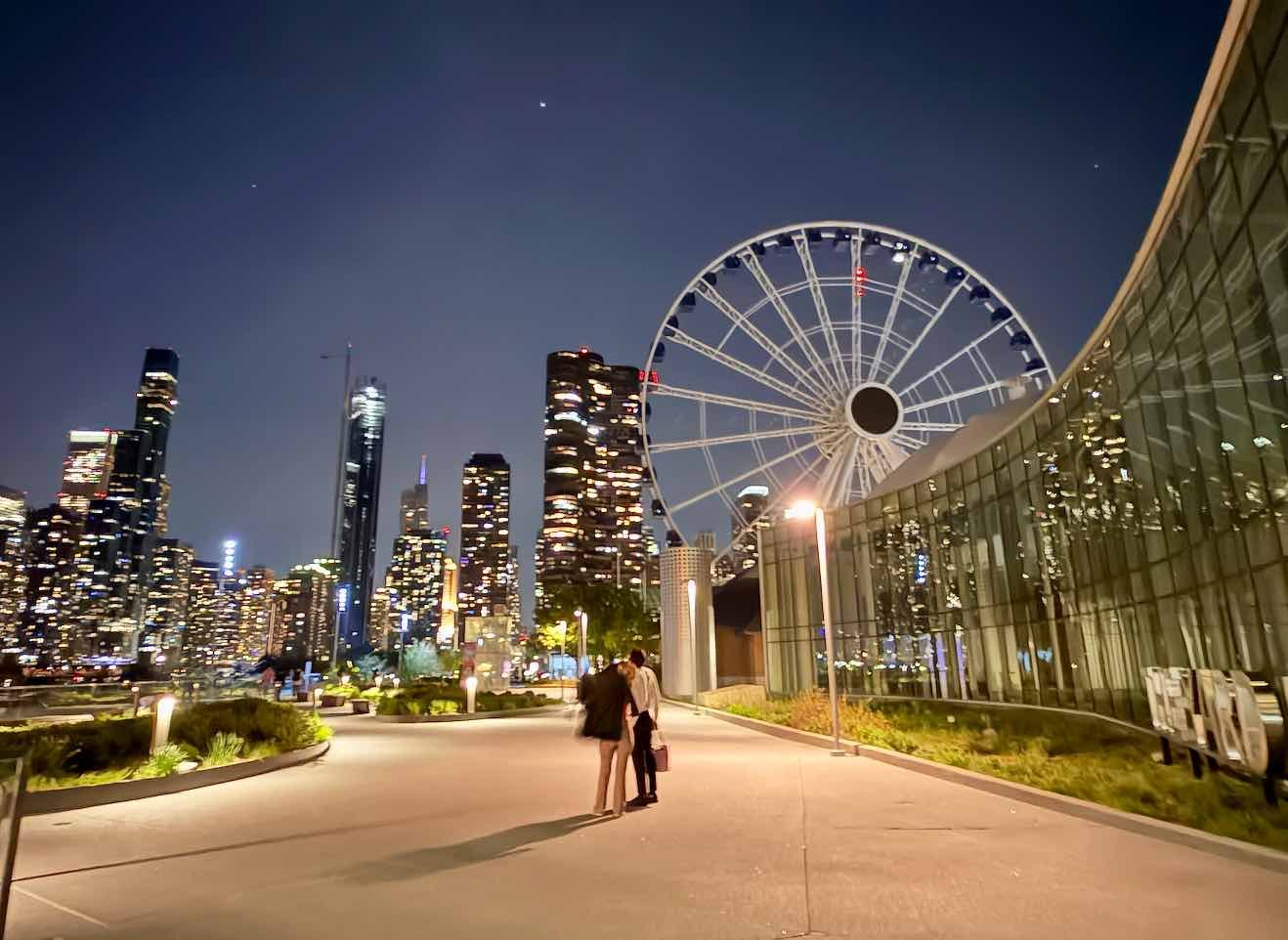
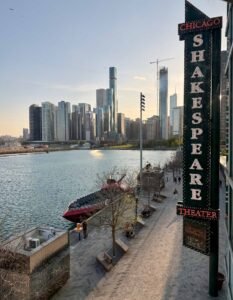
All of the photos in this post are from our April 2026 visit, when we saw The Merry Wives of Windsor at Chicago Shakespeare Theater at Navy Pier on Shakespeare’s birthday, with the skyline glowing behind the stage on the water. The moments through the years aren’t just memories. They’re coordinates on the map of who I am, and a reminder that the places that shaped us never really let us go.
The Bean, the Tourists, and Why I Never Stop Being a Chicago Ambassador
Last time I was on Michigan Avenue on a busy Saturday morning, I spotted a couple ahead of me in the crowd. The husband said confidently, “No, I know — it’s over there,” pointing right. The only thing to the right was the Merchandise Mart.
I asked where they were headed. “The Bean,” his wife said.
“Straight ahead,” I told them. “Across the street.”
She turned to her husband: “See, I told you.”
I love that moment. I love knowing. I love that Chicago has so many layers that even confident visitors get turned around and that anyone who has loved this city long enough can’t help but step in and share it.
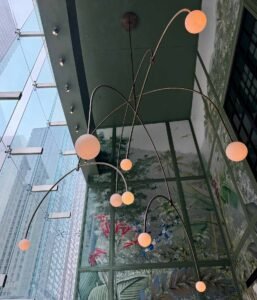
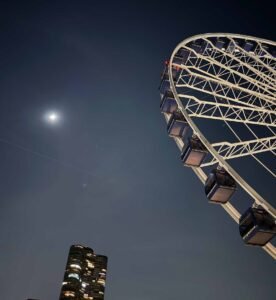
Chicago is consistently ranked one of the best cities to visit and one of the best places to live in the world. The Art Institute of Chicago, Millennium Park, the Chicago Riverwalk, the architectural boat tours on the Chicago River, Navy Pier, Wrigley Field, Cloud Gate, these are world-class experiences. But the real Chicago lives in the details. The building that survived the Great Chicago Fire still anchoring Michigan Avenue. A lobby where light globes float above a painted garden while the skyline watches through the glass. A Ferris wheel turning slowly under a full moon.
Those details are there for everyone. But only some people see them.
We Don’t Just Visit Places. Places Visit Us Back.
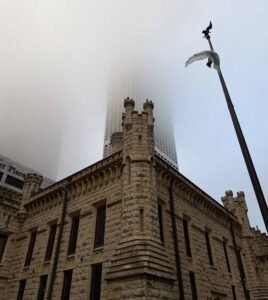
Every time I return to Chicago, something shows up that I didn’t go looking for. A building detail I’ve passed a hundred times and suddenly notice. A reflection in the river at a particular hour. The Water Tower wrapped in fog with a skyscraper dissolving into clouds above it.
These moments happen because I am paying attention. And paying attention is a choice, one that most busy leaders forget to make.
As a Visibility Architect, I have come to believe that presence is not something you perform. It is something you design, the same way Chicago’s architects designed a skyline that still stops people to take notice, and pictures!
The leaders and brands I work with who struggle most with visibility aren’t invisible because they lack talent. They are invisible because they have stopped noticing. They are executing without observing. Producing without pausing. Building without stepping back to see what they are actually making.
Ferris Bueller’s entire philosophy, and John Hughes’s entire philosophy about Chicago, is that the city rewards the people who stop and look. The architecture is there for everyone. The Art Institute of Chicago is open to everyone. The river reflects the sky for everyone.
What would you notice today if you slowed down enough to look?
Presence begins with observation. That’s not a travel lesson. It is a leadership lesson. It is a brand lesson. And Chicago has been teaching it for over 150 years.
“Life moves pretty fast. If you don’t stop and look around once in a while, you could miss it.” Ferris Bueller
Hey Chicago, I’ll See You This Weekend
We’re going back to Chicago this weekend for Father’s Day. Back again in August. And if this year is like last year, probably for Thanksgiving and Christmas and maybe RiotFest and Open House Chicago. Every trip delivers something I didn’t expect.
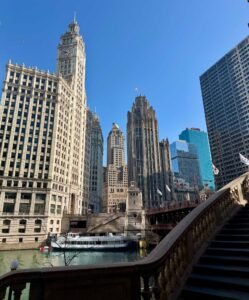
If you’ve never been to Chicago, go. The Art Institute of Chicago alone is worth the trip. So is the architectural boat tour on the Chicago River. So is Shakespeare at Navy Pier on a warm evening. So is simply standing on a bridge and watching the Wrigley Building reflect in the water below. Walk slowly. Look up. Let the city ask you a question.
And if you have left a place that shaped you and wonder whether it still holds your place, it does.
What city changed the way you think? What do you notice when you stop and look around?
Chicago and Visibility: Frequently Asked Questions
Q: Where was Ferris Bueller’s Day Off filmed in Chicago?
A: Ferris Bueller’s Day Off was filmed at multiple Chicago landmarks, including the Art Institute of Chicago, Wrigley Field, the Sears Tower observatory, and along State Street during the Von Steuben Day Parade. Most interior scenes were filmed in Northbrook and Highland Park, Illinois.
Q: What is the leadership lesson from Ferris Bueller’s Day Off?
A: The film’s central lesson is that paying attention to art, architecture, culture, and the people around you is a creative and leadership strategy. Cameron’s scene at the Art Institute demonstrates what happens when leaders get too close to what they’re building and lose perspective.
Q: What does visibility begin with?
A: According to Visibility Architect Barbara Rozgonyi, visibility begins with observation. The leaders and brands that stand out aren’t always the loudest; they are the ones paying closer attention than everyone else.
Q: What is the Brighter Presence framework?
A: Brighter Presence is Barbara Rozgonyi’s visibility framework built on the belief that presence is something you design, not something you perform. It connects photography, travel, leadership, and personal branding through deliberate observation.
Q: What are the best things to do in Chicago?
A: Chicago’s top experiences include the Art Institute of Chicago, architectural boat tours on the Chicago River, Wrigley Field, Cloud Gate in Millennium Park, Navy Pier, Chicago Shakespeare Theater, and the Chicago Riverwalk. The city is consistently ranked one of the best places to visit and live in the world.
About Barbara Rozgonyi
Barbara Rozgonyi is a Visibility Architect™, keynote speaker, marketing futurist, and founder of CoryWest Media. She transforms expertise into visibility, credibility, influence, and opportunity for CEOs, CMOs, association leaders, executives, thought leaders, marketers, and event professionals navigating an AI-powered world.
Recognized as a Top 100 Keynote Speaker to Watch, Barbara combines more than 25 years of experience in marketing, public relations, digital strategy, leadership communications, and emerging technology to guide organizations and leaders from overlooked to unforgettable. Her work has generated millions in earned media value, elevated executive visibility, and strengthened the presence of global brands, associations, and growth-focused organizations.
Barbara is the creator of the Brighter Presence™ framework, publisher of wiredPRworks.com, host of the Brighter Presence podcast, and co-founder of Social Media Club Chicago, one of the nation’s earliest professional social media communities.
She grew up dreaming of Chicago, lived in Wrigleyville, and returns to the city as often as possible, in every season. Her work is built on a simple belief: visibility begins with observation: in cities, in leadership, and in life. Explore more at BarbaraRozgonyi.com.
Some sections of this post were developed with AI writing assistance and edited by Barbara Rozgonyi. All stories, opinions, experiences, and photographs are entirely her own.