AEO in 2026: Earned Media vs. Your Website in AI Answers
AEO in 2026: Why Earned Media and Your Website Both Decide What AI Says About You
By Barbara Rozgonyi
Key Takeaways
- Answer engine optimization (AEO) is the work of improving how often and how accurately AI tools like ChatGPT, Gemini, Perplexity, and Claude mention your business.
- The research agrees earned media is a major input, though figures vary by methodology. Muck Rack found it drives 84% of AI citations, while HubSpot’s data shows citation rates vary widely depending on the engine.
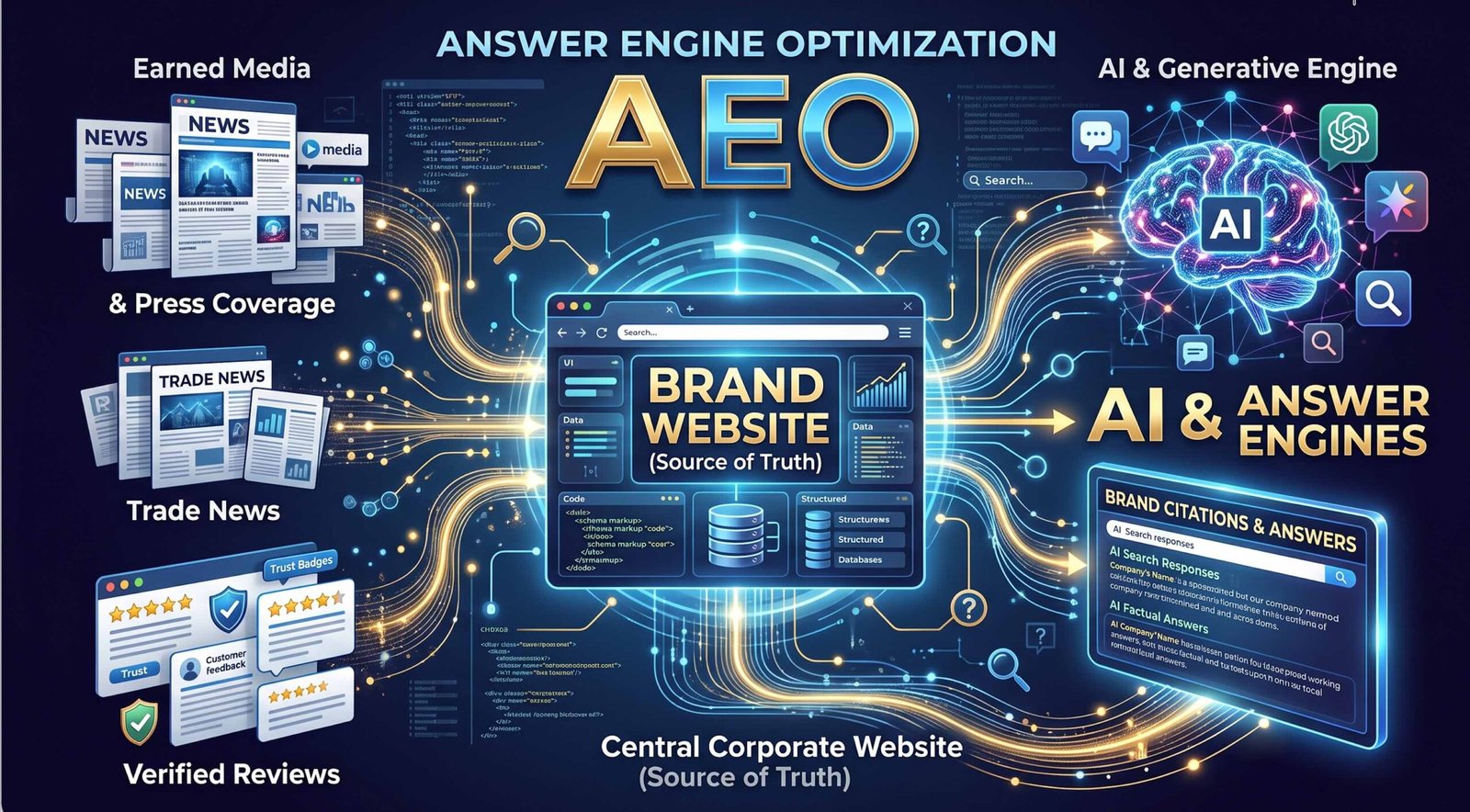
- Your website is the source. Earned media (press, reviews, community mentions) is the proof AI uses to decide whether to believe it.
- Trade coverage and expert quotes matter most when people ask AI what is happening in an industry. Your own pages matter most when they ask how to do something.
- Start by asking the AI tools about yourself. Then fix your pages and earn coverage in the places they already cite, using pitches journalists find relevant. In Cision’s 2026 survey, 82% of journalists said they actively reject irrelevant pitches.
What is Answer Engine Optimization (AEO)?
Answer engine optimization is the practice of improving how often and how accurately your business appears in AI-generated answers. Instead of competing for a click on a list of links, you are competing to be named, described, and cited inside the answer itself.
Many people call this generative engine optimization, or GEO. I use the terms interchangeably because the fundamentals are the same: clear answers, consistent descriptions of who you are, credible third-party proof, and rigorous measurement.
What Does the Research Say AI Cites?
I looked at multiple studies. They ask slightly different questions, which is part of why they land in different places.
| Study | What it looked at | What it found about earned media |
| HubSpot: State of AEO in 2026 | A survey of 1,100+ global marketers plus citation data across ChatGPT, Claude, Perplexity, Gemini, and Google AI Overviews (Dec 2025 to Mar 2026) | PR content shows a 92% citation rate in ChatGPT, 58% in Gemini, 58% in Perplexity, and 6% in Google AI Overviews. |
| Muck Rack: What Is AI Reading? (May 2026) | 25M+ links cited by ChatGPT, Claude, and Gemini | Earned media made up 84% of citations, while paid or advertorial content accounted for 0.3%. Earned media ranged from 82% to 89% across three editions since July 2025. |
| Meltwater Citation Analysis (April 2026) | 5.35M citations analyzed | Earned and news media accounted for 39.5% of citations, while owned and other content made up 50.3%. |
| Stacker & Scrunch AI GEO Study (March 2026) | 87 stories from 30 brands across 2,600+ prompts on 8 AI platforms | Earned distribution produced a 239% median lift in citations over brand-owned publishing alone. |
Muck Rack found journalism alone made up 25% to 27% of citations in every edition and cited it for 46% of industry-trend queries.
Why Do the Studies Disagree?
The numbers differ for four structural reasons, and none of them means one study is simply wrong:
- Definitions: Muck Rack counts journalism, academic research, government sources, encyclopedic sites, and third-party corporate content as earned. Meltwater counted vendor documentation and similar pages as owned, which shrinks the earned share to 39.5%. Under a narrower view, the “84% earned” figure looks closer to a quarter, because journalism alone is 25% to 27% in Muck Rack’s data.
- The Engine: In Meltwater’s data, ChatGPT gave earned and news media 51.1% of its citations, while Claude gave 53% to owned and other content. HubSpot shows a similar swing, with PR cited at a 92% rate in ChatGPT and 6% in Google AI Overviews.
- The Question: Muck Rack reports that when people ask what is happening in an industry, AI reaches for news coverage. When they ask how to do something, it leans on reference content and brand-owned material.
- Methodology: Muck Rack and Meltwater measure share of all citations (what slice of total outgoing links belongs to each media type), whereas HubSpot reports citation rates within specific content categories (how often a specific content format gets cited when indexed). Because they measure different metrics, HubSpot’s table cannot be directly lined up against Muck Rack’s.
Across all research, earned media is a major input. It is not the only one, and every percentage here serves as a directional indicator.
So Which Matters More: Your Website or Earned Media?
Both, and they do different jobs. Your website says who you are and what you know. Everyone else tells AI whether to believe it.
Your Website is the Source
It is the one place where you control the wording, depth, and structure. Owned pages do real work in HubSpot’s dataset: blog posts and informative articles were cited at a 42% rate in AI Overviews, 76% in Gemini, 69% in ChatGPT, and 80% in Perplexity. Product and landing pages reached 86% in ChatGPT. Traditional SEO still feeds this, because HubSpot found that pages ranking higher and for more search terms are significantly more likely to be cited.
Earned Media is the Proof
When trade media, reviewers, and communities describe you the way you describe yourself, answer engines have more reason to repeat it. HubSpot’s report notes that these platforms weigh brand presence, PR, customer advocacy, reviews, and social signals—not just your blog.
If you only publish on your own site, you are the only one vouching for yourself. If you only chase coverage, there may be no clear, accurate reference point for that coverage to link back to.
What I Teach About PR in the AI Era
My PRSA Charlotte session was built on a simple idea: PR still rules, and AI makes it matter more. I included a line from Christopher Penn that this research backs up:
“If you care about AI understanding your business and recommending you, then your biggest investment should be in public relations.”
Andy Crestodina of Orbit Media made the practical point in an interview with Michelle Garrett: the goal is a large, visible digital footprint, but with AI, “it’s more about providing rich, descriptive content that the AI can understand and recommend. It’s less about traditional links and more about ensuring your brand and expertise are well-represented in text.”
I teach this through my 5D WIRED PR Framework: Digital, Direct, Dynamic, Data, and Distinctive. Two of the five map straight onto AEO:
- Data: I put “AI mentions” on the PR dashboard next to engagement, leads, conversions, and trust uplift. If you do not track whether AI mentions you, you cannot tell whether your coverage is working.
- Distinctive Voice: Differentiation builds trust, and uniform content is a missed opportunity. Describing yourself consistently in every bio, boilerplate, and byline gives answer engines a clear picture of who you are.
The hard part is on the other side of the desk. In Cision’s 2026 State of the Media Report, 72% of journalists said fewer than a quarter of the pitches they receive are relevant to their work. The channel the research says AI trusts most is also hard to earn. That is a reason to be selective about where you pitch, not a reason to skip it.
What Do Journalists Say It Takes to Earn Coverage?
If earned media feeds AI, the next question is what earns it. Cision’s 2026 State of the Media Report surveyed 1,899 journalists across 19 markets in January and February 2026:
- Relevance decides everything: 79% said they are most likely to engage with a pitch that fits their beat and audience, 82% will actively reject an irrelevant one, and 72% say fewer than a quarter of pitches received are relevant.
- They want substance, not promotion: The resources journalists want most are data or research (47%), embargoed or early-access information (45%), and access to experts (42%). Press releases came in at 22%, and 53% reject pitches that feel too promotional.
- They still lean on PR: 66% rely on PR-provided content (releases, pitches, media kits) as a primary source for story ideas.
- Credibility is the currency: 50% named accuracy and fact-checking as their biggest challenge, while 49% named resource constraints—a 20 percentage point surge from 29% the previous year. Leaner newsrooms reward sources who make verification easy.
- LinkedIn is where they connect: 62% use LinkedIn most for professional purposes, and 33% call it their single most valuable platform. HubSpot found LinkedIn is also among the most-cited social channels in AI answers.
- Keep AI in a supporting role: 53% oppose receiving AI-generated pitches or releases. Most want direct email (97%), a single follow-up (64%), and a reply within 24 hours (52%).
This aligns with what I teach under Direct in the 5D WIRED PR Framework: resonance beats reach.
Action Plan: What Should You Do First?
- Ask the engines about yourself: Run the questions your customers or members ask through ChatGPT, Perplexity, Gemini, and Claude. Note whether you appear, how you are described, and which sources get cited.
- Audit your best pages: Look for clear headings, direct answers, and structured FAQs. HubSpot found these correlate with higher citation frequency.
- Maintain consistent messaging everywhere: Use one standardized name, title, expertise statement, and organization description across your website, author bios, podcasts, and press releases.
- Pitch the outlets AI already cites: The sources identified in step one form your primary target list. Focus on trade and news outlets for industry-trend queries.
- Offer quotable data: Research and original data are what journalists want most (47% in Cision’s survey vs. 22% for press releases), giving AI concrete facts to repeat.
- Build authority in recognized hubs: LinkedIn and YouTube are among the most-cited channels. As AEO expert Krista Doyle notes, a mention in a niche industry community often carries more weight than a generic high-authority backlink.
- Measure quarterly: Add AI mentions to your PR dashboard and re-run your core brand queries every quarter.
How Does Barbara Rozgonyi Work with AI, PR, and Websites?
If you want to ensure AI search models recognize your business and recommend your expertise, I partner with executives, association leaders, and growing companies through three distinct engagements:
- AI Visibility & AEO Audits: A structured evaluation of how ChatGPT, Perplexity, Claude, and Gemini currently interpret, cite, and describe your brand, complete with a tactical roadmap to eliminate brand confusion and data voids.
- Fractional CMO & Strategic Advisory: Hands-on strategic leadership through CoryWest Media to implement the 5D WIRED PR Framework, bridge PR with AEO/GEO, and close The Expert Gap™ across your digital ecosystem.
- Keynotes & Executive Workshops: Customized, high-impact keynotes and interactive working sessions for corporate retreats, industry associations, and national events navigating AI search disruption and digital visibility.
How This Helps You Win
- Established Small Businesses: Even without a dedicated PR team, your local press, trade publications, and review sites feed AI knowledge graphs. A quick audit and one consistent bio go a long way.
- Associations & Nonprofits: Members ask AI where to find education, vendors, and speakers. Clear resource pages and trade press coverage ensure your programs get cited.
- Sales & Marketing Teams: Consistency is your lever. When every deck, bio, and press boilerplate says something different, AI generates a muddled picture of your business.
- Speakers & Executives: AI is actively forming a profile of you. Consistent bylines, podcast appearances, and speaking summaries help AI describe your expertise accurately.
Frequently Asked Questions
Is earned media the only driver for AEO?
No. It is the largest single input in several studies, but not the only one. Muck Rack highlights earned media heavily, while Meltwater and HubSpot show owned content driving significant visibility—especially for how-to questions and specific engines like Claude.
Does a press release count as earned media?
Not by itself. Muck Rack tracks press releases as a minor fraction of citations, whereas journalism accounts for 25% to 27%. In Cision’s survey, only 22% of journalists wanted more press releases compared to 47% seeking data or research. A release works best as a tool to secure earned coverage.
Do I still need SEO?
Yes. HubSpot found that pages ranking higher and for more search terms in traditional search are significantly more likely to be cited in AI answers.
Which AI platform should I focus on?
Focus on the platforms your target audience uses. Citation behavior varies: HubSpot reports ChatGPT favors comparison content while AI Overviews favor blog posts, and Meltwater found ChatGPT leans on earned media while Claude leans on owned content.
How do I know if AI mentions me?
Perform manual queries quarterly by typing standard customer questions into ChatGPT, Perplexity, Gemini, and Claude. Track whether your brand appears, how it is described, and which sources are linked.
About the Author
Barbara Rozgonyi is an internationally recognized keynote speaker, personal branding and visibility strategist, AI advisor, and founder of Brighter Presence™ and CoryWest Media. Named a Top 100 Speaker to Watch and publisher of wiredPRworks.com (a Top 40 PR blog), she helps experienced leaders, associations, and entrepreneurs close The Expert Gap™—making their value unmistakable, trusted, and chosen in an AI-driven world.
With two decades of marketing, PR consulting, and sales training experience, Barbara served as co-dean of the NSA Illinois Speaker Academy and on the boards of NSA Illinois and NSA Carolinas. She has delivered keynotes, workshops, and corporate advisory for organizations including Boston Scientific, Bosch, Association Forum, MDRT, IMEX, PCMA, PRSA, AMA, NSA, and MPI, and hosts the Brighter Presence podcast.