AI Keynote Speaker on Leadership to Explore Trust and Human Creativity at GLOTADALS 2026 Global Summit
Explore what AI in art, sports, and entertainment means for business owners, associations, meeting planners, and consultants through an AI keynote speaker on leadership.
Pixels, Plays & Presence: How Leaders Keep the Human Signal Strong as AI Transforms Art, Sports & Entertainment
By Barbara Rozgonyi | November 15, 2026
As a photographer, I choose where to focus and what belongs in the frame. Those choices shape the story.
AI brings another set of choices into focus. When technology can generate an image, analyze an athlete’s performance, or reproduce a voice, what do we want it to help people accomplish? Which decisions need our judgment?
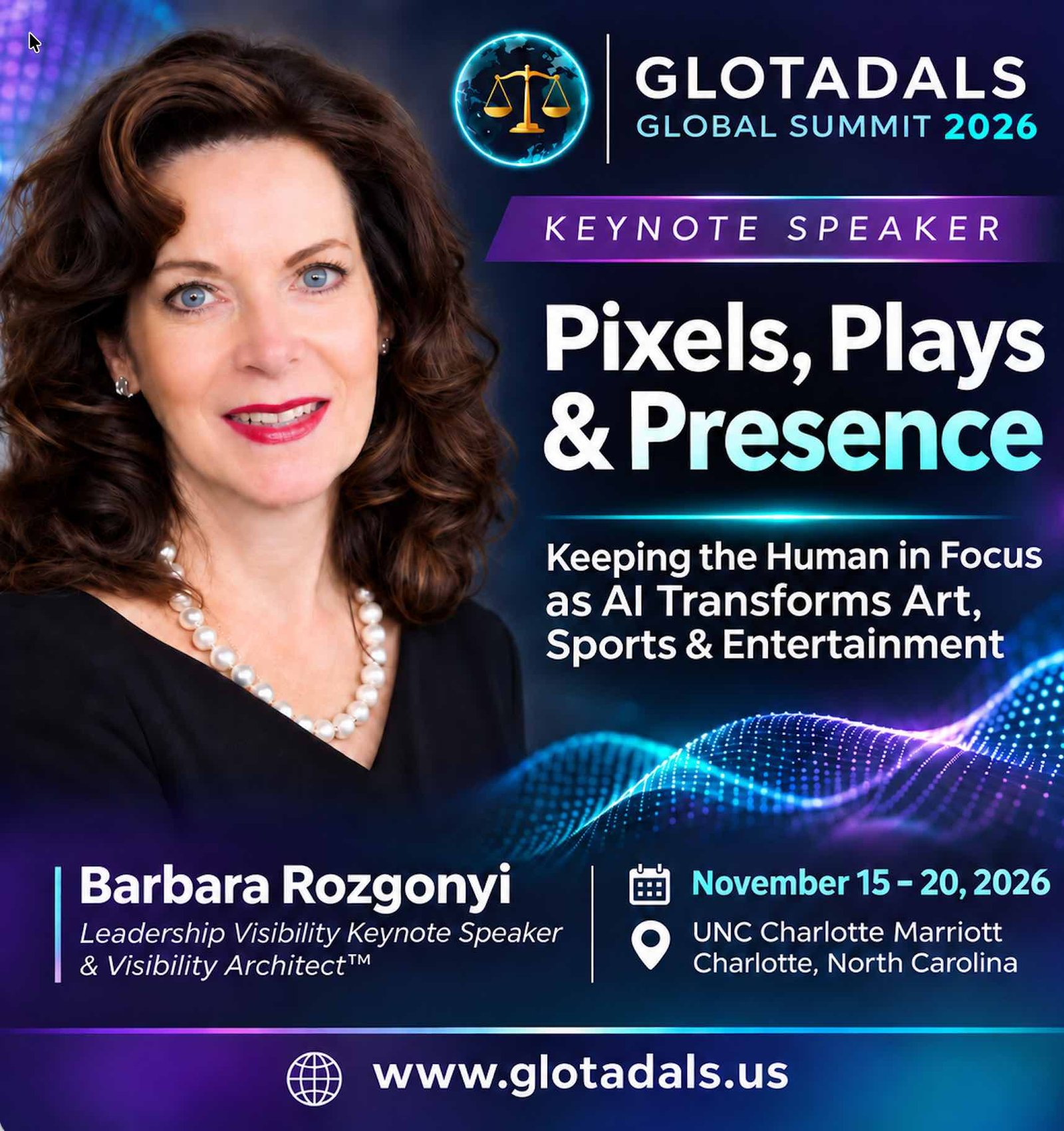
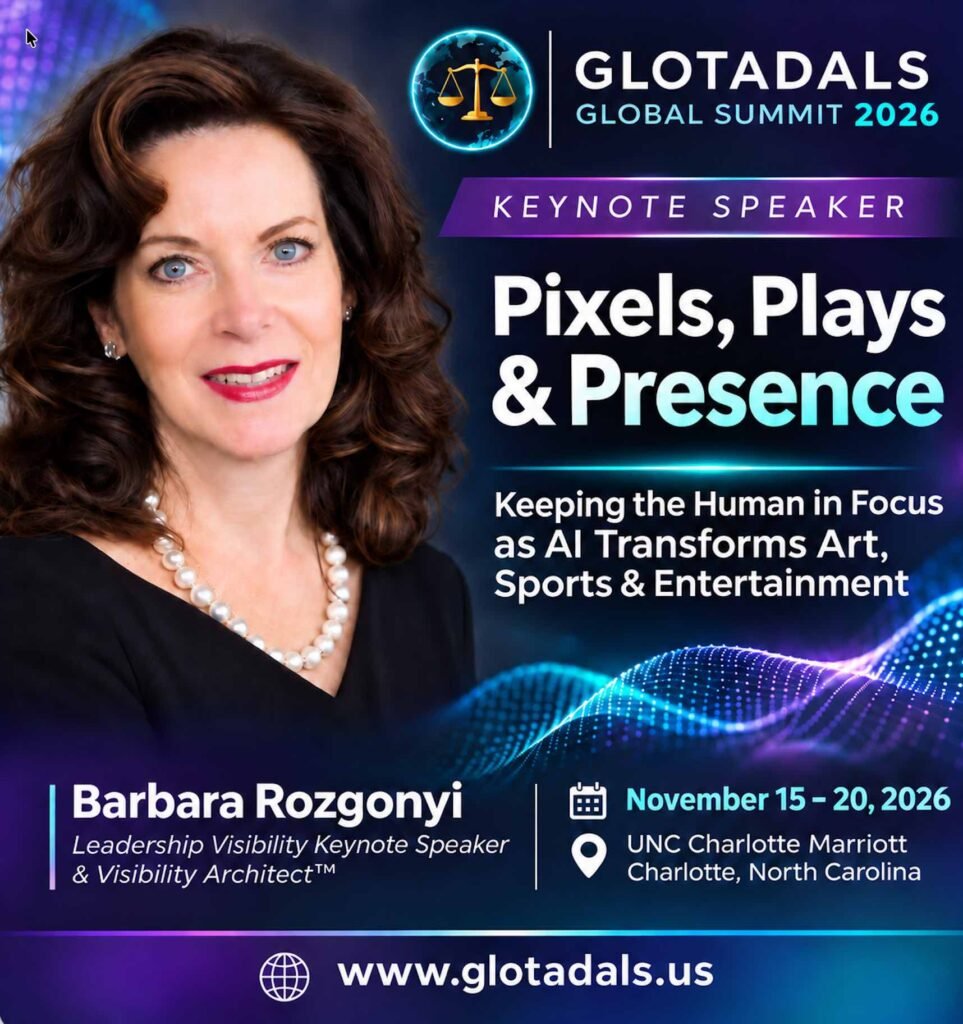
Those questions are at the heart of my GLOTADALS Global Summit keynote, “Pixels, Plays & Presence: Keeping the Human in Focus as AI Transforms Art, Sports & Entertainment.”
You don’t have to work in those industries to recognize the challenge. Small-business owners, association leaders, meeting planners, and consultants face their own versions whenever they use AI to communicate, serve clients, or create an experience.
What This Means for Your Business, Members, Clients, or Event
Leaders can evaluate AI projects through three questions: What improves for people? Who has a meaningful say? Who receives the value? The answers help connect technology decisions to customer trust, professional expertise, and audience needs.
Here is where that becomes practical:
- Small-business owners: Decide where AI can save effort while keeping your customer knowledge, service standards, and distinctive voice evident.
- Association leaders: Help members connect their expertise to changing expectations, and choose AI initiatives that address a clear member need.
- Meeting planners: Build a program that makes AI relevant to your audience. Evaluate AI-assisted event materials for accuracy and tone, and preserve the human choices that give the event its character.
- Consultants: Make your analysis, recommendations, and accountability visible so clients understand the expertise behind an AI-assisted deliverable.
Across these roles, the goal is to make better decisions about where AI belongs and how people contribute.
In my work, I often return to this: What gets seen shapes what gets chosen.
As AI influences what people see, hear, and consider, leaders need to understand how those impressions are formed.
AI in Art: What Is the Creative Intention?
For his Unsupervised exhibition at the Museum of Modern Art, on view in 2022–2023, artist Refik Anadol used AI to interpret publicly available data from MoMA’s collection, spanning more than 200 years of art. The installation generated changing imagery influenced by environmental inputs such as light and movement. Source: MoMA. www.moma.org
The project offers an example of AI expanding an artist’s creative possibilities. My leadership takeaway is that the intention behind the work deserves as much attention as the technology producing it.
That applies to a business campaign, an association publication, or a conference’s visual identity. What should people understand or feel? What makes the result relevant to this particular audience?
Put it to work: Before approving an AI-assisted creative project, ask the team to explain its audience, source materials, human contribution, and definition of success.
For a meeting planner, that might mean checking whether a striking promotional image communicates the actual event experience and welcomes the people you want to attend.
AI in Sports: Who Controls the Data?
In February 2025, FIFPRO announced a partnership with Sports Data Labs to develop a consent-based platform through which professional footballers could collect, control, and monetize their data. The proposed approach included player-controlled permissions and opportunities to share in revenue from uses players choose to authorize. Source: FIFPRO. www.fifpro.org
The announcement describes an intended model, rather than established outcomes. What stands out is the role it gives players in decisions about their information.
The question extends beyond the playing field: when people generate valuable data, how do they participate in decisions about its use?
For businesses, associations, consultants, and event teams, consider the information people entrust to you. Do clients, members, or attendees understand how their information may be used with AI?
Put it to work: Map one AI-enabled data project. Identify who provides the information, who authorizes its use, who can question a decision, and who benefits.
AI in Entertainment: Does More Output Create More Value?
On April 20, 2026, Deezer reported that fully AI-generated tracks accounted for roughly 44% of its daily music uploads, while representing only 1%–3% of total streams on the platform. Those figures describe Deezer’s service at that time, rather than the entire music industry. Source: Deezer. newsroom-deezer.com
Production volume and audience interest are different measures.
The parallel is useful for anyone publishing content or planning a program: generating more material does not establish that people find it valuable.
Entertainment also offers examples of people negotiating how their identities may be used. SAG-AFTRA’s 2025 Interactive Media Agreement includes consent and disclosure requirements for covered uses of AI digital replicas. Source: SAG-AFTRA. www.sagaftra.org
Put it to work: Before using an AI-generated voice, spokesperson, or likeness, establish the permissions, disclosures, and human review your project needs. Assess its usefulness against the communication goal.
For event teams, this also prompts a practical conversation about how speakers’ contributions, recordings, and identities will be used.
The Human Advantage Test: Three Questions for Your Next AI Project
To connect these examples to everyday decisions, I use the Human Advantage Test as a discussion lens.
| Lens | Ask this question | Make this clear |
|---|---|---|
| Capability | What can people create, do, or experience better? | The expected benefit and how you will assess it. |
| Agency | Who gets a meaningful say? | People’s choices, permissions, and responsibility for decisions. |
| Value | Who benefits, receives credit, and gets paid? | How people contributing expertise, work, or data participate. |
Imagine an association creating an AI-assisted promotional video featuring a speaker’s voice.
Capability asks whether the video helps prospective attendees understand the program. Agency asks whether the speaker understands and approves the intended use. Value asks how the speaker’s contribution is credited and whether compensation or other terms are appropriate.
The same questions can guide a client presentation, a marketing campaign, or a member-service pilot.
Keeping Your Expertise Recognizable
By human signal, I mean the recognizable judgment, perspective, relationships, and accountability people bring to their work.
That connects to what I call the Expert Gap™: the distance between earned expertise and the recognition it receives.
You can publish frequently and still leave your best expertise difficult to recognize. Help your audience see:
- Whose knowledge informed the work.
- Why you made a particular recommendation.
- How it addresses their situation.
- Who stands behind the result.
For your next AI project, bring the Human Advantage Test into one meeting. Write down the intended benefit, the people affected, and how value will be shared. Choose one unresolved question to address before moving forward.
For Meeting Planners: Make AI Relevant to Your Audience
A useful AI program gives attendees a way to connect the topic to their own decisions.
For this keynote, the intended takeaways are to help participants:
- Recognize how AI applications in art, sports, and entertainment relate to their work.
- Identify where human judgment, permission, and accountability matter.
- Apply capability, agency, and value to one AI project.
- Explain the human expertise behind an AI-assisted result.
For association conferences, business events, and leadership meetings, these questions offer a starting point for discussion that can continue after the session.
Explore Pixels, Plays & Presence at GLOTADALS
I’ll deliver “Pixels, Plays & Presence: Keeping the Human in Focus as AI Transforms Art, Sports & Entertainment” as part of Forum L at the GLOTADALS Global Summit.
- Date: Thursday, November 19, 2026
- Forum session: 10:30 a.m.–noon ET
- Location: UNC Charlotte Marriott Hotel & Conference Center, Charlotte, North Carolina
- Program details: GLOTADALS summit schedule
Planning an association conference, business event, or leadership meeting? Let’s discuss your audience, the decisions they face, and what you want them to leave ready to do. Explore my keynote programs and inquire about availability.
Frequently Asked Questions
How is AI being used in art, sports, and entertainment?
Examples include generative art, analysis of player data, AI-generated music, and digital replicas of performers. Each application raises different questions about creative direction, information use, permissions, and human contribution.
What can small businesses and consultants learn from these examples?
They can use the same questions to evaluate their own projects: Does this help clients or customers? Who should approve its use? Does the result make the business’s expertise and responsibility clear?
Why is this topic relevant to associations and meeting planners?
AI decisions affect both event delivery and the professional challenges audiences face. The Human Advantage Test provides a discussion structure for connecting AI to member needs, program relevance, trust, and practical decisions.
What does human presence mean when organizations use AI?
Human presence means people’s judgment, perspective, relationships, and accountability remain recognizable. Leaders demonstrate it by explaining decisions, acknowledging contributions, listening to those affected, and taking responsibility for outcomes.
About Barbara Rozgonyi
Barbara Rozgonyi is an AI leadership keynote speaker, corporate trainer, and founder of CoryWest Media. With more than three decades of experience in public relations, marketing communications, community leadership, and digital strategy, she guides leaders and organizations to close the Expert Gap™, so their expertise becomes recognized, trusted, and chosen. Based in Charlotte, North Carolina, Barbara brings strategic communications, photography, and visual storytelling to her work with businesses, consultants, associations, and conference audiences worldwide.
Get Connected
LinkedIn | YouTube | Instagram | Facebook | X | Flickr | Podcast | Newsletter
AI Keynote Speaker and Corporate Training Events
Planning a conference, association meeting, or leadership retreat and want to know if Barbara Rozgonyi is the right fit for your audience? Send your keynote speaker or corporate trainer request with your event, goals, and timeline.